

Views: 222 Author: Rebecca Publish Time: 2026-02-14 Origin: Site


Content Menu
● What Is a Check Valve in Wastewater Systems?
● Why Selecting the Right Wastewater Check Valve Matters
● Key Questions to Define Your Wastewater Application
>> Hydraulic and System Conditions
>> Media, Solids, and Chemical Environment
● Understanding Check Valve Sizing and Flow Velocity
>> Typical Velocity Considerations
● Common Types of Check Valves for Wastewater
>> Silent, Axial, or Non-Slam Check Valves
● How Media and Solids Impact Check Valve Selection
● Material Selection for Corrosive Wastewater Environments
● Minimizing Water Hammer and Valve Slam in Wastewater Lines
● Practical Step-by-Step Process to Select a Wastewater Check Valve
● Useful Accessories and Monitoring Options
● Real-World Wastewater Scenario
● 2026 Best-Practice Trends in Wastewater Check Valves
● Quick Selection Table for Wastewater Check Valves
● Action Checklist Before You Issue a Specification
● Frequently Asked Questions (FAQ)
>> Q1. What is the most important factor when selecting a check valve for wastewater?
>> Q2. Why do some check valves cause loud banging noises when pumps stop?
>> Q3. Which check valve type is best for raw sewage with rags and wipes?
>> Q4. How often should wastewater check valves be inspected?
>> Q5. Can the wrong check valve increase my energy consumption?
Choosing the right check valve for wastewater is critical to protect pumps, prevent backflow, reduce water hammer, and lower lifecycle costs in treatment plants and municipal networks. This guide explains how to select, size, and specify check valves using a practical, system-level approach that supports reliable, long-term operation.

A check valve is a one-way valve that allows flow in the forward direction and automatically closes to prevent reverse flow when the pump stops or system pressure reverses. In wastewater applications, check valves protect pumps, piping, and downstream equipment from backflow, contamination, and pressure surges.
Typical locations include pump discharge headers, lift stations, sludge lines, effluent lines, and return activated sludge systems. Because wastewater often contains solids, fibers, and corrosive chemicals, the selected check valve must handle both hydraulic dynamics and media characteristics reliably over time.
A poorly selected or sized check valve can cause serious hydrodynamic problems, from water hammer to premature wear and leakage. Common consequences include:
- Water hammer and valve slam, causing noise, vibration, and high surge pressures in the pipeline.
- Increased maintenance due to chattering, erosion of seating surfaces, and spring or hinge failures.
- Clogging or blockage when solids and stringy materials catch on internal components or restricted ports.
- Shortened pump life and potential reverse rotation if backflow is not properly controlled.
Misalignment between valve type, cracking pressure, and pipeline dynamics can raise energy consumption, increase surge pressures, and shorten service life in grit-laden wastewater flows. Selecting the correct valve type, size, and material at design stage pays off in fewer failures, longer service life, and lower total cost of ownership.
Before you choose a check valve, you must understand the entire system, not just the connection size. Use the following checklist to clarify your application.
Ask these questions early in the design process:
- What is the flow rate or range of flow rates (GPM or L/s)?
- What are the pressures under static and pumping conditions (PSI or m head)?
- What is the pipeline diameter and material?
- Is it a single-pump or multi-pump system?
- Is it a header system with multiple branches?
- What is the length and elevation profile of the discharge pipeline?
- Is the discharge line open (gravity) or closed (pressurized)?
These parameters define flow velocity, head loss, and surge behavior, which are crucial for selecting a check valve that closes smoothly and operates in the correct velocity window.
Wastewater is rarely clean, so the type of media is critical:
- What is the media (raw sewage, grey water, sludge, industrial effluent)?
- What size and concentration of solids are present?
- Are there fibers or stringy materials that can wrap around components?
- What chemicals or additives are present (for example, chlorides, acids, disinfectants)?
- What is the temperature range of the fluid?
For grey water or raw sewage with solids and rags, a full-port check valve is strongly recommended to allow solids to pass through without snagging on hinge arms or internal restrictions.
Installation conditions directly affect material selection and corrosion resistance:
- Is the valve indoors or outdoors?
- Is it in a coastal or high-humidity environment with salty air?
- Is the valve located in buried chambers, pits, or exposed above ground?
In coastal or aggressive atmospheres, stainless steel internal components and corrosion-resistant coatings can dramatically extend valve life.
Correct sizing is about flow velocity, not only matching the pipe nominal diameter. Each check valve design has an optimal velocity range where it opens fully, avoids chattering, and minimizes pressure loss.
- At too high velocity, surge potential increases when the pump trips and the valve may slam shut, causing water hammer.
- At too low velocity, the disc or ball may not fully open, leading to chattering and accelerated wear of seats, springs, and hinges.
- Operating in the “sweet spot” minimizes head loss, noise, and mechanical stress.
If you know flow rate and pipe size, your valve supplier can help calculate flow velocity and recommend the best size and style.
Different designs perform best within certain velocity bands. As a general rule of thumb:
- Swing check valves suit moderate velocities and constant flows.
- Ball check valves handle low to moderate velocities with dirty wastewater.
- Silent or axial designs are used at higher velocities where non-slam behavior is critical.
Actual ranges depend on manufacturer data, so always confirm with technical documentation.
Different check valve designs perform very differently in wastewater conditions. Selecting the right type for your media and duty cycle is essential.
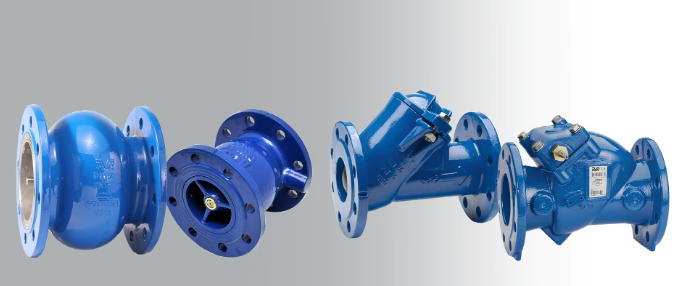
Swing check valves use a hinged disc that swings open with forward flow and closes when flow reverses.
Advantages:
- Full-port designs allow passage of solids and stringy materials with minimal obstruction.
- Widely used on municipal wastewater and clean water pumping systems.
Best for:
- Constant flow applications where pressure drop must be minimized.
- Pump discharge lines in treatment plants and municipal networks.
A robust swing style check valve with a broad velocity range is a versatile choice for both wastewater and clean water applications.
Ball check valves use a free-moving ball that lifts off the seat under forward flow and reseats during backflow.
Advantages:
- Simple flow path with no hinge arms that could trap solids.
- Suitable for dirty wastewater and sludge.
Best for:
- Wastewater with higher solids content.
- Small to medium line sizes where compact installation and easy access are desired.
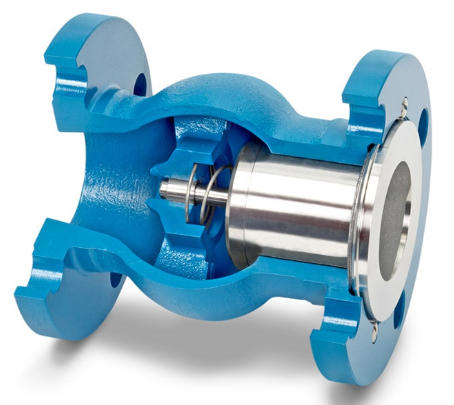
Silent or axial check valves are spring-assisted and close rapidly as the forward flow decelerates.
Advantages:
- Excellent non-slam behavior and water hammer reduction.
- Compact wafer or insert designs save space and weight.
Best for:
- Systems where surge and noise control are critical.
- Higher velocity, cleaner water or light solids applications.
For heavily contaminated wastewater with large solids, many nozzle or dual-disc designs are not recommended because solids can become trapped and impede operation.
The type and size of solids in wastewater strongly influence valve choice.
- For grey water or raw sewage, choose full-port swing or ball check valves to reduce the risk of rags and debris catching on internal components.
- For slurries and sludge with abrasive solids, select wear-resistant materials and robust seat designs.
- Avoid narrow or complex internal geometries in high-solids lines, as they are more likely to clog.
Practical example: in a municipal lift station handling raw sewage with wipes and fibers, a full-port swing check or ball check valve will typically offer more reliable, low-maintenance operation than a narrow-bore nozzle check valve.
Valve body and internal component materials must withstand chemical attack and environmental corrosion.
- In systems with chlorides, industrial chemicals, or disinfectants, seat and trim materials should be chosen for chemical compatibility.
- In coastal or saline atmospheres, stainless steel internals and corrosion-resistant exteriors can significantly improve durability.
- Elastomer selection (for example, EPDM or NBR) must consider temperature, pH, and chemical exposure.
Consult chemical compatibility tables and valve manufacturer data sheets to confirm that the chosen materials are suitable for the specific wastewater composition and installation environment.
Water hammer is one of the most common and costly check valve problems in pumping systems. It occurs when flow is forced to stop or change direction suddenly, causing a pressure surge that travels through the pipeline.
When a pump trips, a slow-closing or oversized check valve can slam shut and convert kinetic energy into high surge pressures, noise, and vibration. These surges can damage pumps, pipe supports, and fittings, and increase maintenance costs.
To reduce water hammer in wastewater applications:
1. Match closing characteristics of the valve to the system dynamics, including pump shut-down time, pipeline length, and elevation.
2. Use fast-closing, non-slam check valves in systems prone to rapid flow reversals.
3. Avoid oversizing the valve, which can slow disc closure and increase slam.
4. Consider hydraulic surge analysis for long rising mains or critical installations.
Use this step-by-step workflow to select the right valve for your next project.
1. Define system data
- Flow range, pressures, pipe size, length, elevation profile, pump type.
2. Characterize the media
- Wastewater type, solids size and concentration, chemicals, temperature.
3. Determine performance priorities
- Non-slam behavior, low head loss, solids handling, maintenance access, cost.
4. Choose candidate valve type
- Swing check, ball check, silent or axial, or other specialized design according to the above criteria.
5. Size for velocity and head loss
- Confirm the selected size operates within the recommended velocity range and meets maximum head loss criteria.
6. Select materials and coatings
- Match body, trim, and elastomers to chemical and environmental conditions.
7. Specify accessories and options
- Position indicators, backflow devices, limit switches, and any external damping or assisted closing features that the system may need.
Documenting each step improves traceability and ensures the selected valve matches both current and future operating conditions.
Modern check valves can be equipped with accessories that enhance control and monitoring.
- Position indicator: shows the internal disc position during operation and shutdown, useful for troubleshooting and confirming open or closed status.
- Backflow device: allows controlled backflow for pump priming, line draining, or system testing when required.
- Limit switches: provide remote indication of valve position for integration with SCADA or plant monitoring systems.
These options help operators optimize uptime, detect abnormal conditions early, and align with modern digital plant strategies.
Consider a municipal lift station pumping raw sewage to a treatment plant through a long rising main. The pipeline has significant elevation gain and several hundred meters of length, making it susceptible to surges when the pump trips. The wastewater contains wipes, rags, and grit, so solids handling is a major concern.
A robust solution in this scenario typically includes:
- A full-port swing check valve or heavy-duty ball check valve to pass solids without clogging.
- Careful sizing to operate in an optimal velocity range to avoid chattering at low flows.
- Non-slam or assisted-closing features, combined with surge analysis and possible surge control devices, to limit water hammer during pump trips.
By treating the system as a whole, operators can avoid nuisance alarms, costly maintenance, and unplanned overflows.
Recent trends are reshaping how engineers select check valves for wastewater systems.
- Higher energy efficiency demands are pushing designers to minimize head loss, making accurate velocity-based sizing more important.
- Stricter environmental regulations increase the cost of spills and overflows, emphasizing reliable non-slam performance and robust backflow prevention.
- Digital monitoring via limit switches and remote indicators is becoming standard in new plants and retrofits.
Plants that integrate these best practices in valve selection and monitoring often achieve fewer unplanned outages and better long-term performance of their pumping assets.
| Application scenario | Media / solids level | Recommended valve type | Key priorities |
|---|---|---|---|
| Raw sewage lift station | High solids, rags, fibers | Full-port swing or ball check | Solids passage, low clogging risk |
| Treated effluent discharge | Low solids | Swing or silent/axial check | Low head loss, surge control |
| Sludge recirculation | High solids, abrasive | Ball or specialized sludge check | Wear resistance, easy maintenance |
| Industrial wastewater with chemicals | Variable chemistry, moderate solids | Chemically compatible swing or ball | Material compatibility, corrosion resistance |
| Clean water in the same plant (reference) | Minimal solids | Swing, axial, or wafer check | Efficiency, compact layout |
Always confirm compatibility with specific manufacturer data and local standards before final selection.
Before finalizing your specification for a wastewater check valve, make sure you can answer:
- Have you defined flow rate, pressure, and velocity ranges for all operating modes?
- Have you characterized solids size, type, and concentration, as well as chemicals in the media?
- Have you chosen the valve type based on solids handling and surge behavior, not just initial cost?
- Have you verified materials and elastomers for both fluid and atmospheric conditions?
- Have you considered water hammer and whether a non-slam or assisted-closing design is needed?
- Have you defined any required accessories, such as position indicators or limit switches?
If you are designing or upgrading a wastewater or municipal pipeline system, now is the ideal time to review your check valve strategy to reduce failures, surges, and lifecycle costs. Share your complete system data with an experienced valve manufacturer or engineering partner and request a detailed check valve selection based on your specific media, hydraulics, and installation environment. By taking a system-wide approach and applying the principles in this guide, you can significantly improve the reliability, safety, and efficiency of your wastewater pumping installations.
Contact us to get more information!
The most important factor is a full understanding of the system hydraulics and media, including flow rate, pressure, solids content, and discharge conditions, because these determine the appropriate valve type and size.
This is usually due to water hammer caused by a slow-closing or oversized valve that allows reverse flow to build momentum before slamming shut, creating high pressure surges and noise.
For raw sewage with significant solids and stringy materials, a full-port swing or ball check valve is typically preferred, as it offers a smoother flow path and reduces the risk of clogging.
Inspection frequency depends on duty cycle and media, but many plants perform at least annual inspections, with more frequent checks on high-solids or critical lines to detect wear or clogging early.
Yes. An incorrectly sized or inappropriate valve type can add unnecessary head loss, cause chattering, and force pumps to work harder, increasing energy consumption and accelerating equipment wear.
1. https://www.flomatic.com/news/how-to-select-the-right-check-valve-in-a-waste-water-application/
2. https://www.flomatic.com/news/ball-check-valve-can-reduce-maintenance-and-roping-in-wastewater-pumping-stations/
3. https://www.avkvalves.eu/en/insights/how-to/how-to-choose-check-valve
4. https://www.ttpumps.com/knowledge-hub/how-to-guides/what-is-a-check-valve
5. https://www.valmatic.com/Portals/0/pdfs/DesignSelectionCheckValves.pdf
6. https://www.avkindia.com/en/insights/product-insights/check-valves/how-to-choose-the-right-check-valve
7. https://www.xhsparkvalve.com/es/a-practical-7-step-guide-to-selecting-the-right-check-valve-for-pump-systems/


