

Views: 222 Author: Wode Valve Publish Time: 2026-05-29 Origin: Site


Valve connection types are one of the most overlooked choices in ball valve projects, yet in my experience they often decide whether a water treatment or municipal pipeline system runs reliably for 10 years or becomes a maintenance headache in 10 months. In this guide, I'll walk through valve connection types from the perspective of a ball valve manufacturer working daily with global distributors, EPC contractors, and municipal end users, and show you how to choose the right connection for real-world projects. [quickcreator]
When I review failed valves in water plants or city networks, the root cause is rarely "the ball valve itself is bad" — it's far more often "the wrong connection type for the job." A well-chosen connection reduces leakage risk, simplifies maintenance, and keeps your total cost of ownership under control over the full life of the pipeline. [allwayvalves]
From an engineering and procurement viewpoint, the connection choice affects:
- System safety and leakage performance in buried mains, pump rooms, and treatment skids. [control]
- Installation time and labor skill level (critical on EPC projects with tight schedules). [quickcreator]
- Standardization and interchangeability across plants and regions. [allwayvalves]
For ball valves in water treatment and municipal pipelines, the most common end connections you will encounter are flanged, threaded, welded, and compression, with unions and other specialized options used in specific spots such as instrument lines or compact skids.
At the simplest level, a valve connection is the way a valve body mechanically and hydraulically joins to the piping or equipment around it. The "right" connection must match both the process conditions (pressure, temperature, medium) and the field context (pipe size, accessibility, and maintenance philosophy). [control]
Choosing appropriately helps you to:
- Design a system that can be assembled, tested, and maintained without constant cut‑outs and reworks.
- Avoid leakage points at threaded or gasketed joints under cyclic pressure or water hammer. [control]
- Keep capex and long‑term opex balanced by using welded, flanged, or threaded joints where they make the most sense. [allwayvalves]
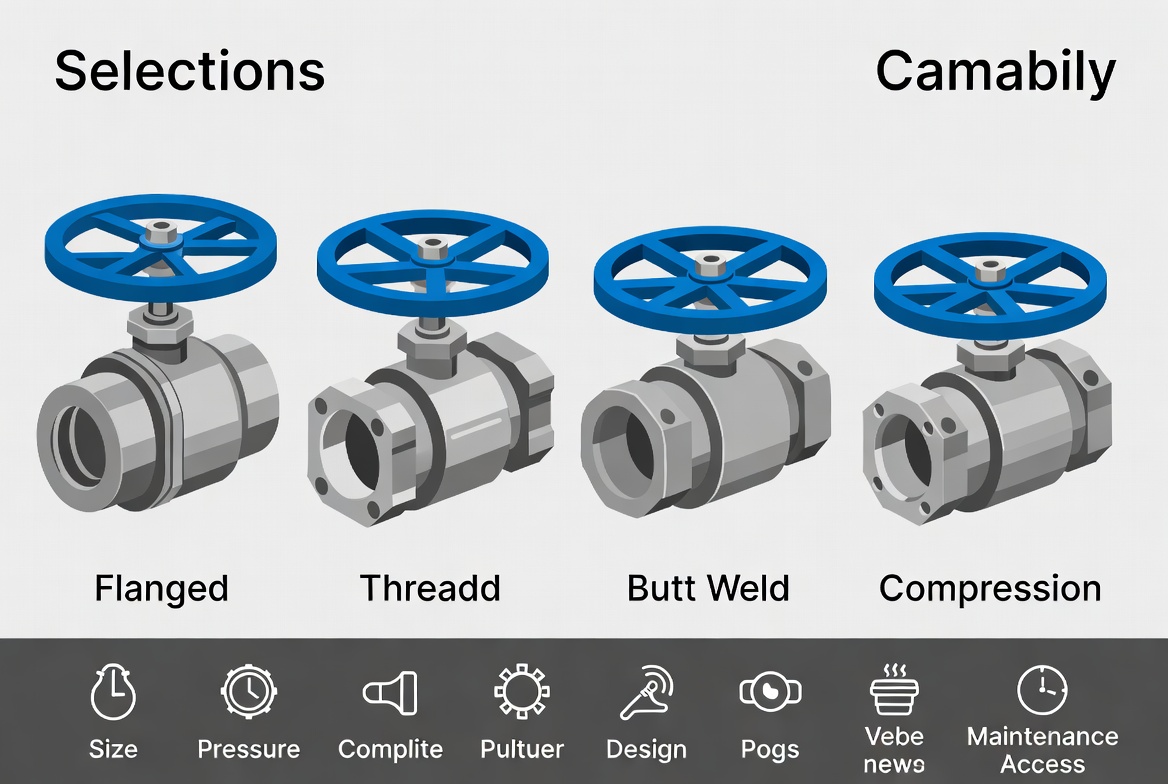
Below is an at‑a‑glance view of the main connection types you'll see on ball valves for water and municipal applications.
| Connection type | Typical size range | Pressure/temperature capability | Maintenance & access | Typical municipal / water uses |
|---|---|---|---|---|
| Flanged | DN50 and above | Medium to high, depends on flange rating | Excellent – valves can be unbolted | Water treatment plants, pumping stations, trunk mains near equipment |
| Threaded (NPT/BSP) | DN15–DN50 | Low to medium | Moderate – can be disassembled, but threads can seize | Small branches, building services, non‑critical by‑passes |
| Welded (butt / socket) | DN25 and above | High, suitable for severe conditions | Poor – requires cutting to replace | Buried lines, high‑pressure or critical lines, long straight runs (control) |
| Compression | DN8–DN32 typically | Low to medium | Good – relatively easy to replace components | Instrument lines, small service lines, local connections to equipment |
| Union / other special | DN8–DN50 | Varies by design | Very good – designed for frequent removal | Meters, instruments, compact skids, local isolation in equipment rooms |
For a ball valve manufacturer like Tianjin Wode Valve, these connection choices are integrated into product families so distributors and EPCs can standardize by size, pressure class, and connection type across entire projects. [wodevalve]
A flanged end ball valve uses two mating flanges, a gasket, and a bolted joint to create a pressure‑tight, serviceable connection. In water and municipal service, carbon steel or ductile iron flanges with elastomer gaskets (EPDM, NBR) are typical, depending on the medium and standard.
Common global standards include:
- ASME B16.5 – pipe flanges and flanged fittings from NPS 1/2 to 24.
- EN 1092‑1 – circular flanges for pipes, valves, and fittings in PN classes.
Specifying the right pressure rating (e.g., Class 150 / PN16) and facing type (RF, FF) is essential to ensure interchangeability across projects. [allwayvalves]
From project experience, flanged connections are usually preferred when:
- Pipe sizes are DN50 and above and valves must be removed for periodic inspection or replacement.
- The line is part of a treatment plant, pump station, or large valve chamber where access is available.
- There is moderate to high pressure but welded joints would reduce maintainability. [control]
Key advantages:
- Excellent maintainability – you can remove the valve without cutting the pipe.
- Good mechanical strength with structurally sound bolting and gasket selection.
- Standardization – flanges follow well‑defined dimensions, helpful for EPCs with global sourcing. [allwayvalves]
However, in tight underground chambers or congested galleries, flanged valves can be bulky and require clear bolt‑up space. They also demand proper bolt torqueing and gasket selection to avoid relaxation and leaks over time.
In poorly controlled field conditions, common issues I see include:
- Mixed bolt materials causing uneven creep.
- Gaskets not rated for the temperature or disinfectant chemicals in the water.
- Flange face damage during transport or handling.
Threaded ends – whether NPT, BSP, or ISO metric – are very common on small‑bore ball valves. They are widely used in building services, small process lines, and non‑critical branches in water systems.
Key thread standards include, for example:
- ASME B1.20.1 – general purpose pipe threads (inch).
- ISO 7‑1 / EN 10226 – pipe threads where pressure‑tight joints are made on the threads.
Advantages:
- Lower initial cost compared with flange assemblies on small sizes.
- Easy installation with basic tools; ideal where welding is restricted.
- Compact and lightweight, useful in tight service chases or equipment cabinets.
Limitations:
- Not recommended for larger diameters or higher pressures where bending moments can stress the threads. [control]
- Gradual loosening and leakage are possible, especially under vibration or thermal cycling.
- Requires compatible sealant (PTFE tape, thread compound) and correct tightening technique.
In a municipal setting, my own practice is to limit threaded ball valves to small auxiliary lines, drain lines, and non‑critical bypasses, while using flanged or welded connections for main and trunk lines. [control]
On ball valves, you'll mainly see socket weld (SW) and butt weld (BW) ends.
- Socket weld: the pipe is inserted into a recessed socket on the valve, then fillet‑welded around the circumference; popular in small‑bore, high‑pressure lines.
- Butt weld: the pipe and valve end are beveled and aligned, then butt‑welded; this is the standard for larger sizes and critical pipelines. [control]
Welded ball valves are the first choice when:
- The line is buried or otherwise inaccessible, making future bolt re‑tightening impossible.
- The system experiences high pressure, frequent cycling, or severe water hammer where gasketed joints are a risk. [control]
- The owner is optimizing for long‑term integrity over ease of replacement. [allwayvalves]
Proper welding must follow recognized standards (for example, API 1104 for pipelines or ASME BPVC Section IX for procedure qualifications) and requires qualified welders and NDT.
The main trade‑off with welded ball valves is maintainability: replacing a welded valve means cutting the pipeline and preparing new weld ends. For EPC contractors and municipalities, this means planning:
- Adequate isolation points on either side of critical welded valves.
- By‑passes or redundant lines where total shutdown is unacceptable.
Compression fittings use a nut and ferrule to generate a tight seal around the tube or small pipe. They are especially common in:
- Instrument air lines
- Sampling lines and chemical dosing points
- Small‑bore utility lines around treatment equipment
They allow relatively quick assembly and disassembly but are sensitive to overtightening, vibration, and bending at the connection.
Unions and similar "quick service" connections are often integrated into compact ball valves used for:
- Flow meters and small control valves on skids.
- Local isolation inside equipment cabinets.
They are chosen not for raw strength but for repeatable disassembly, for example during annual calibration or cleaning.
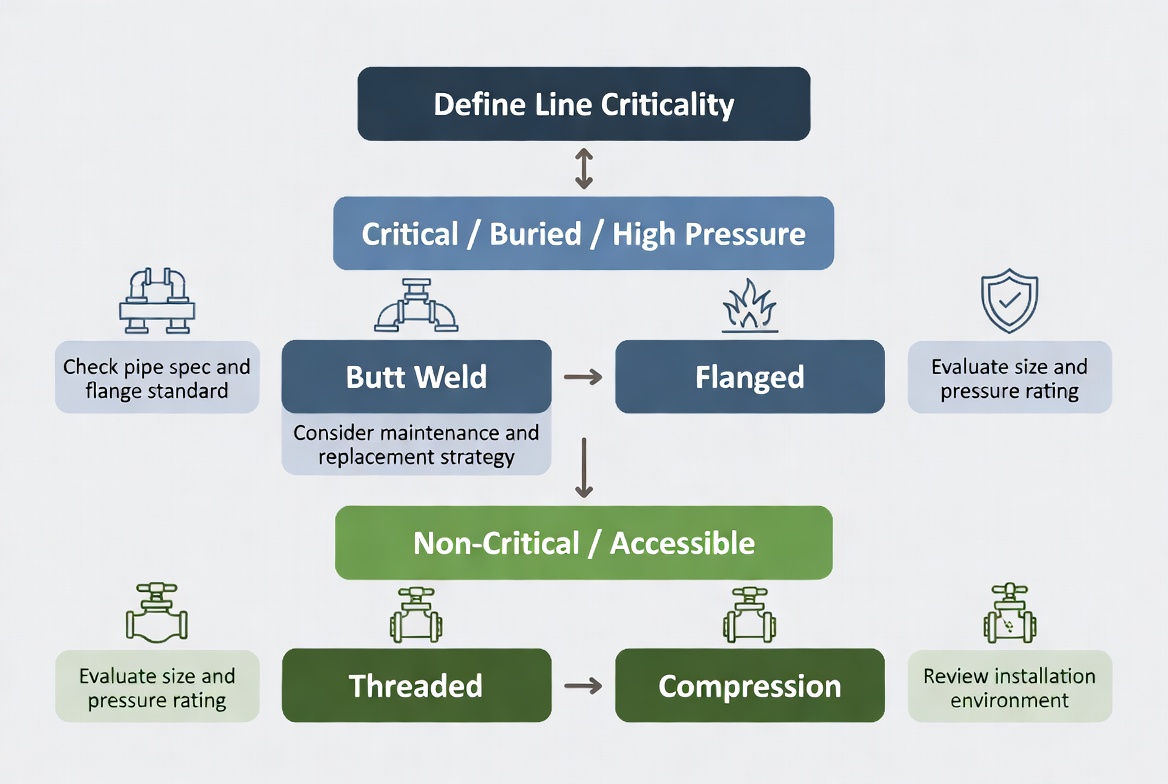
Here is a practical, field‑tested selection process I use when advising engineers and buyers on ball valve connection types for water and municipal projects. [allwayvalves]
Ask first: What happens if this connection leaks or fails?
- For trunk mains, key isolation points, or high‑energy lines, prioritize flanged or welded ends for mechanical integrity. [control]
- For non‑critical branches, drains, and local utility lines, threaded or compression connections may be acceptable.
Align with your project pipe specifications:
- Pipe size and material, pressure rating (e.g., PN16, Class 150).
- Design standards (e.g., API 608 for ball valves, API 598 or ISO 5208 for testing). [allwayvalves]
- Regional flange and thread standards (ASME vs EN).
A ball valve data sheet should clearly state the end connection type, standard, and rating so procurement cannot accidentally mix incompatible flanges or threads. [allwayvalves]
- Choose flanged if you want to remove valves easily for refurbishment or future upgrades.
- Choose welded in buried or highly critical lines where you want to minimize joints and potential leak points. [control]
- Choose threaded or compression where access is easy and the medium and pressure are relatively benign.
Welded joints may appear cheaper initially than full flanged assemblies, but replacement cost is higher since you need cutting and re‑welding. Flanged valves cost more up front, but when you spread maintenance over a 20‑year municipal asset life, they often come out ahead in key locations. [allwayvalves]
From reviewing RFQs and data sheets from different markets, several recurring mistakes lead to connection problems later in the project. [quickcreator]
- Mixing standards: specifying an EN 1092‑1 flange on the valve but pairing it with an ASME B16.5 pipe system.
- Underestimating future maintenance: choosing welded ball valves in positions where you will want to swap out for upgraded coatings or actuators. [allwayvalves]
- Over‑relying on threaded joints on lines that actually see pressure spikes or vibration from pumps starting and stopping. [control]
- Missing documentation requirements: not asking for test reports, CMTRs, and coating certificates tied to the actual valve serial number. [allwayvalves]
A more robust approach is to:
- Define a clear connection philosophy by line category (trunk, distribution, plant, building service).
- Build that into the project valve list and data sheets from the start.
- Work with a manufacturer who can supply the same ball valve design with multiple end connections, so you don't mix internal quality levels just because the end connections differ. [wodevalve]
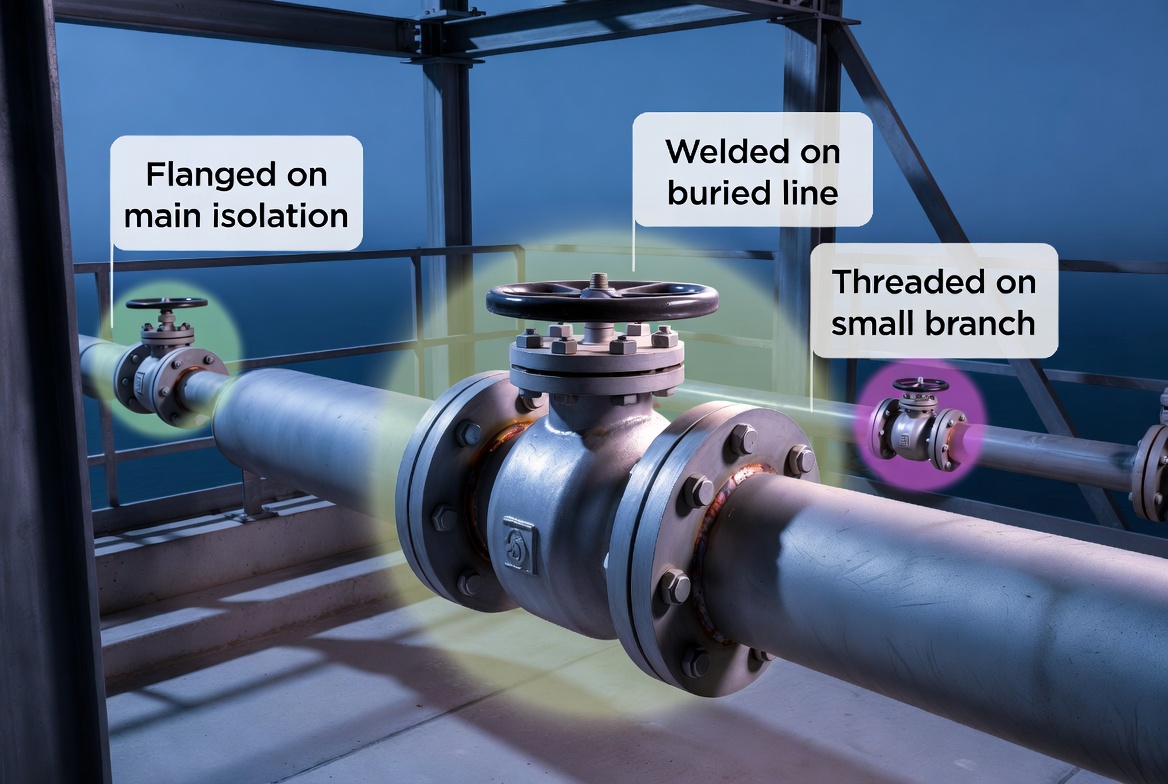
On a recent municipal upgrade, a typical connection strategy for ball valves looked like this (simplified and anonymized based on similar industry practices). [control]
- Water treatment plant manifolds (DN150–DN300)
- Connection: Flanged ball valves for main isolation, with standardized flange class and facing.
- Rationale: Frequent access, structured shutdown planning, clear need for replaceability.
- Buried transmission main (DN300–DN600)
- Connection: Welded butt‑end ball valves with coated bodies and extension stems to ground level.
- Rationale: Minimize gasket joints underground, maximize long‑term tightness.
- Chemical dosing lines and instrument bypasses (DN15–DN40)
- Connection: Threaded or compression ball valves, depending on country standards and chemical compatibility.
- Rationale: Compact, easy to replace small‑bore components.
The lesson: connection choice is not one‑size‑fits‑all; it is a system‑level decision aligned with each segment's role and risk profile. [allwayvalves]
From a UX perspective, this is how I encourage readers to think about valve connections when they land on a manufacturer's site:
- Start with the pipe spec, not the catalog: check what flange, thread, and welding standards your project already uses. [allwayvalves]
- Ask for application guidance, not just a price: reputable manufacturers and distributors should be able to validate your connection choices against pressure, medium, and maintenance needs. [quickcreator]
- Look for transparent documentation: test certificates, materials traceability. [workshopdigital]
For global distributors and EPCs, it's also smart to align connection types with local contractor skills: in some regions, good welding capacity is abundant; in others, a flanged approach actually reduces risk despite higher hardware cost. [blog.saleslayer]
If you are specifying valves for:
- A new water treatment plant
- A city distribution upgrade
- Or a large EPC pumping station project
it's worth having your connection strategy reviewed by the valve manufacturer early. Manufacturers like Tianjin Wode Valve can help you rationalize ball valve sizes, pressure classes, and connection types across a project so you simplify installation and procurement while staying compliant with regional standards. [wodevalve]
For critical buried mains, butt‑welded connections are often preferred because they minimize joints and gasket interfaces, reducing long‑term leakage risk. However, design codes, inspection access, and replacement strategy must all be considered. [control]
Threaded connections are generally limited to small‑bore, low‑to‑medium pressure services and can suffer from leakage over time, especially under vibration. For higher pressures or larger diameters, flanged or welded ends are a safer choice. [control]
Ensure your data sheets specify both the flange standard and pressure class (for example, ASME B16.5 Class 150 or EN 1092‑1 PN16) and avoid mixing EN and ASME systems on the same line. Always confirm bolt hole patterns and facing type with the manufacturer. [allwayvalves]
For critical applications, you should request pressure test reports, material test certificates for pressure‑containing parts, and coating/lining certificates, ideally linked to each valve's serial number. This supports both compliance and future troubleshooting. [allwayvalves]
Connections that are hard to replace (like welded) may reduce leaks but increase replacement cost, while flanged connections cost more initially but simplify maintenance and retrofits. Matching connection type to each line's risk and access level is key to optimizing lifecycle cost. [allwayvalves]
1. ValveMan. "Understanding Different Types of Valve Connections and Fittings."
https://valveman.com/blog/understanding-different-types-of-valve-connections-and-fittings/
2. Workshop Digital. "An SEO Guide to E‑E‑A‑T."
https://www.workshopdigital.com/blog/googles-e-e-a-t-and-seo-guidelines/ [workshopdigital]
3. QuickCreator. "Industrial SEO Best Practices for Pumps, Valves & Flow Control (2025)."
https://quickcreator.io/blog/industrial-seo-best-practices-pumps-valves-flow-control-2025/ [quickcreator]
4. Allway Valves. "Industrial Valve Procurement Guide: How to Source, Specify, and Avoid Counterfeit Valves."
https://allwayvalves.com/industrial-valve-procurement-guide-how-to-source-specify-and-avoid-counterfeit-valves/ [allwayvalves]
5. Control.com. "Introduction to Valve Sizing: A Step‑by‑Step Guide."
https://control.com/industry-articles/introduction-to-valve-sizing-a-step-by-step-guide/ [control]
6. WODE Valve. "About Us – WODE VALVE."
https://www.wodevalve.com/aboutus.html [wodevalve]
7. Sales Layer. "SEO for Manufacturing Companies: The 2026 Strategy Guide."
https://blog.saleslayer.com/seo-for-manufacturing-companies [blog.saleslayer]


