

Views: 245 Author: Wode Valve Publish Time: 2026-06-29 Origin: Site


Choosing the right valve size is not just a catalog decision. In water treatment, municipal pipelines, and industrial systems, an incorrect size can affect flow performance, pressure drop, installation time, and long-term reliability.
For buyers, engineers, and distributors, understanding how valve sizes are measured is essential for specifying the right product, comparing suppliers, and avoiding costly mistakes.
Valve size affects more than the pipe connection. It influences flow capacity, system pressure, equipment compatibility, and even maintenance access.
In municipal and water treatment applications, a valve that is too small can restrict flow and increase energy loss. A valve that is too large may add unnecessary cost and complicate system balance. For EPC contractors and distributors, correct sizing also reduces installation errors and project delays.
In practice, the best sizing decision usually depends on four factors:
- Nominal pipe size.
- Actual flow requirement.
- Pressure and temperature conditions.
- Connection standard and face-to-face dimensions.
Valve size is often misunderstood because the listed size is not always the valve's exact internal diameter. In most industrial catalogs, the size refers to nominal size, which is a standardized designation used to match the valve to the pipe system.
That means a "2-inch valve" is not necessarily measured as exactly 2 inches inside or outside. Instead, it is a reference size that helps engineers, installers, and procurement teams select compatible components.
For global projects, this distinction is important because different regions use different sizing systems:
- Imperial sizes: common in North America and some international catalogs.
- Metric sizes: common in many municipal and infrastructure projects.
- DN designation: widely used in international technical documentation.
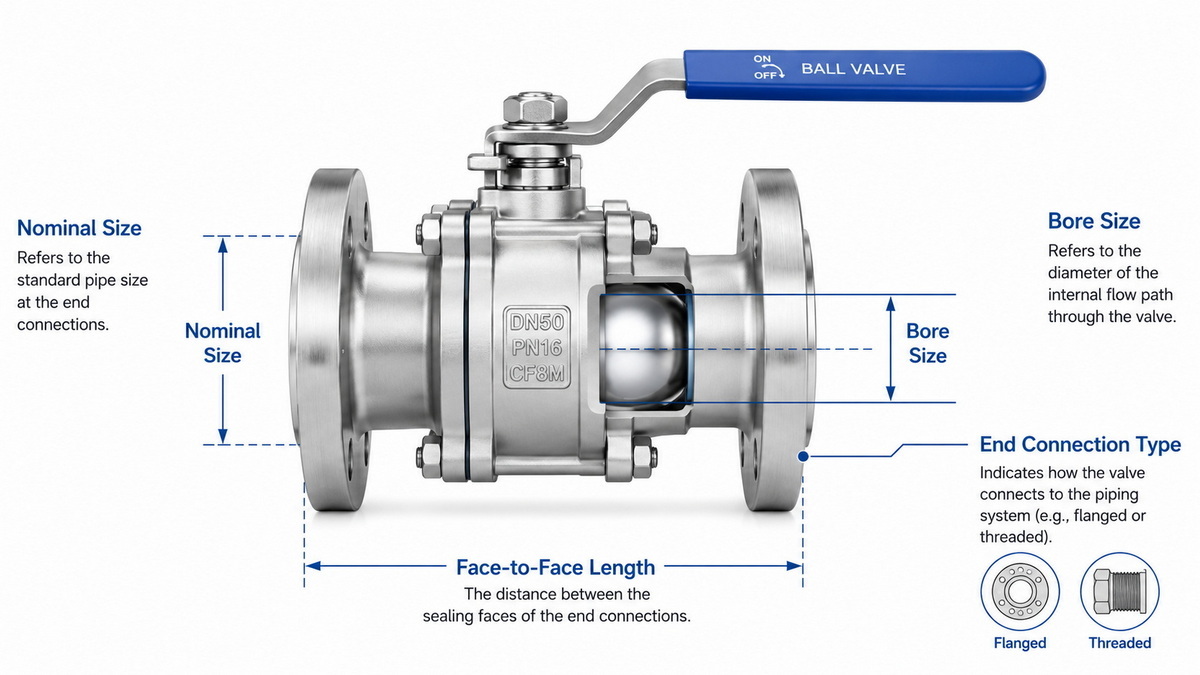
Valve measurement usually involves more than one dimension. To evaluate a ball valve correctly, you should check the following:
This is the basic size label, such as DN50 or 2 inch. It is the starting point for matching the valve to the pipeline.
This refers to how the valve connects to the pipeline, such as:
- Threaded ends.
- Flanged ends.
- Socket weld ends.
- Butt weld ends.
This is the distance between the two ends of the valve body. It is especially important in replacement projects and retrofit installations.
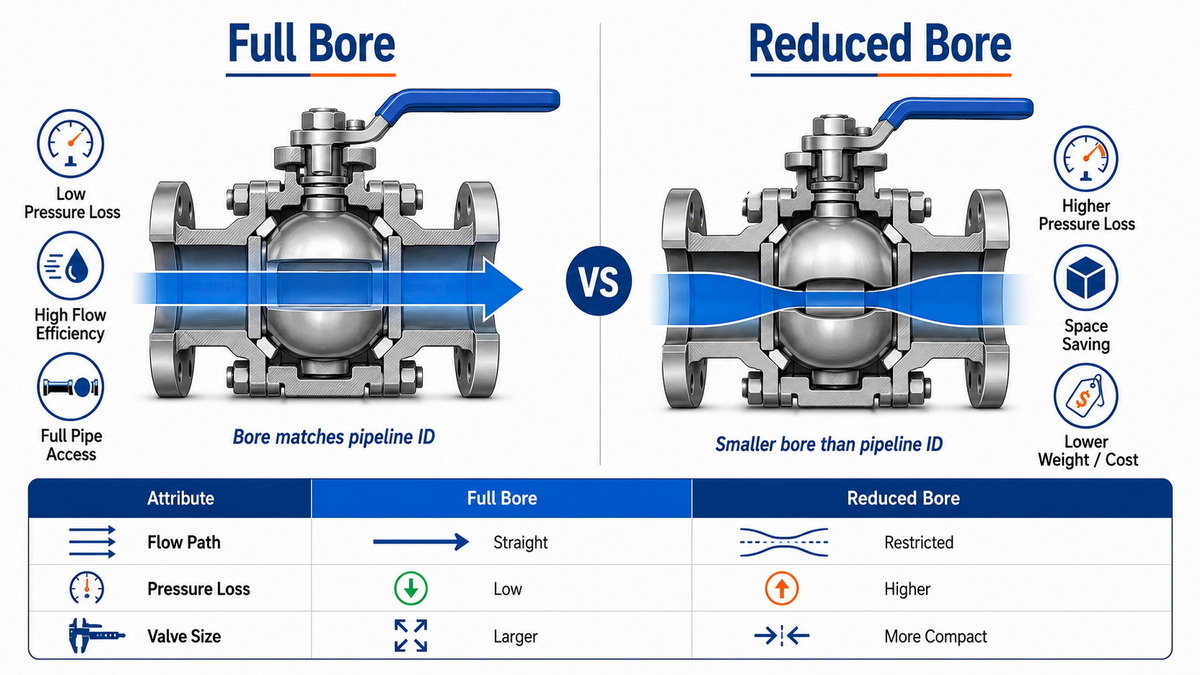
In ball valves, bore size refers to the opening through the ball. A full bore valve offers minimal flow restriction, while a reduced bore valve is more compact and economical.
These include body height, handle clearance, flange diameter, and installation envelope. These measurements matter when space is limited.
One of the most common mistakes in procurement is assuming that all size labels mean the same thing.
A valve marked 2 inch may correspond to DN50, but the actual body dimensions, port opening, and installation length may vary by design and standard. That is why engineers should always check the technical drawing instead of relying on the size label alone.
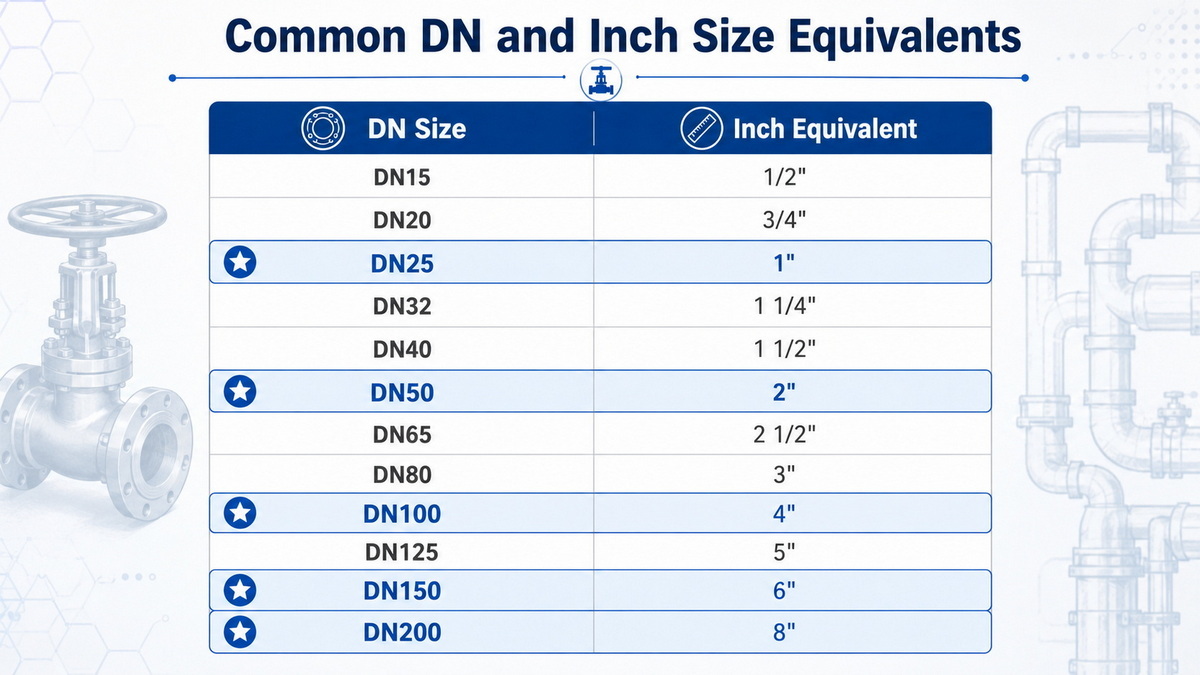
Here is a simple comparison:
| Nominal Size | Common DN Equivalent | Practical Use |
|---|---|---|
| 1 inch | DN25 | Small process lines, service connections |
| 2 inch | DN50 | Building services, water distribution |
| 4 inch | DN100 | Municipal piping, treatment systems |
| 6 inch | DN150 | Larger flow lines, pump stations |
| 8 inch | DN200 | Main transmission and infrastructure |
The exact dimensions should always be confirmed against the manufacturer's drawing and the applicable standard.
For ball valves, bore design is one of the most important sizing decisions.
A full bore ball valve has an internal opening close to the pipe's nominal diameter. It is often preferred when low pressure loss, pigging compatibility, or higher flow efficiency is required.
A reduced bore ball valve has a smaller opening. It is generally lighter, more compact, and more cost-effective, especially in systems where absolute maximum flow is not the top priority.
- When flow restriction must be minimized.
- When pipeline cleaning tools may pass through the line.
- When energy efficiency is a priority.
- When system design requires lower pressure loss.
- When compact size is important.
- When project cost needs tighter control.
- When the application allows some flow resistance.
- When valve space is limited.
Even experienced buyers sometimes make sizing errors because they focus only on the nominal label.
The most common mistakes are:
1. Ignoring the pressure class.
2. Choosing by pipe size only, without checking flow needs.
3. Overlooking face-to-face length.
4. Confusing threaded, flanged, and welded ends.
5. Assuming all DN or inch equivalents are identical across standards.
These mistakes can create mismatch during installation, leakage risk, or expensive rework on site.
For procurement teams and project engineers, a simple sizing workflow can save time and reduce risk.
Define the application, media, pressure, temperature, and flow target.
Check whether the project follows ANSI, ISO, DIN, BS, or another standard.
Select the valve size that fits the line size and connection type.
Confirm whether full bore or reduced bore is needed and whether the pressure rating is sufficient.
Review the manufacturer's dimensional drawing before placing the order.
This workflow is especially useful for EPC projects where one incorrect specification can affect multiple downstream items.
For international buyers, dimensional drawings are not optional. They are the most reliable way to verify compatibility before procurement.
A good drawing should show:
- Nominal size.
- End-to-end length.
- Body height.
- Flange details.
- Bore dimensions.
- Handle or actuator clearance.
For custom projects, drawings also help distributors and brand partners ensure consistency across repeated orders and replacement needs.
In water treatment and municipal pipeline systems, sizing should be treated as a system decision, not just a product decision.
From an engineering perspective, the right valve size should support three goals:
- Stable flow performance.
- Low installation risk.
- Long service life.
That is why many project teams prefer to align valve selection with the pipeline design package, pump curve, and maintenance strategy rather than choosing from a generic catalog listing.
Valve sizing is easier when the manufacturer supports engineering review, not just sales fulfillment.
A reliable supplier should provide:
- Clear technical drawings.
- Consistent dimensional control.
- Standard-compliant documentation.
- Application guidance for water and municipal systems.
- Fast response on sizing verification.
For distributors, EPC contractors, and international valve brands, this level of support reduces project risk and builds long-term trust.
At Tianjin Wode Valve Co., Ltd., we focus on ball valve solutions for water treatment and municipal pipeline applications. Our role is not only to supply valves, but also to help customers select the right specification for their system requirements.
We work with global distributors, EPC contractors, and international brands that need dependable product consistency, technical clarity, and responsive support. If your project depends on accurate sizing, dimensional control, and application fit, technical alignment should start before the purchase order is placed.
CTA: Contact us with your pipeline size, pressure class, and connection standard, and our engineering team can help verify the right ball valve specification for your project.
Not always. Valve size is usually a nominal designation, so it should be checked against the actual drawing and connection standard.
DN is a metric nominal size system, while inch size is an imperial naming system. They are often equivalent in practice, but dimensional verification is still required.
Full bore means the internal opening is close to the pipeline diameter, which helps reduce flow resistance.
Face-to-face length determines whether the valve fits correctly in the installed pipeline layout, especially in replacement jobs.
Check the nominal size, end connection, pressure class, bore type, and dimensional drawing before ordering.
1- [Sales Layer: SEO for Manufacturing Companies]
2- [Hashmeta: SEO for Manufacturing Companies: Complete Industrial Marketing Guide]
3- [Konstruct Digital: SEO for Manufacturers]


