

Views: 256 Author: Wode Valve Publish Time: 2026-07-06 Origin: Site


Content Menu
● What Is an Actuated Ball Valve?
● When to Choose an Actuated Ball Valve
● When a Solenoid Valve Is the Better Fit
● New Selection Insights for 2026
● Practical Comparison for Water Projects
● Why This Matters for OEMs and Distributors
● How Tianjin Wode Valve Can Add Value
● FAQ
>> 1. What is the main difference between an actuated ball valve and a solenoid valve?
>> 2. Which valve is better for water treatment systems?
>> 3. Can a solenoid valve handle dirty water?
>> 4. Which valve uses less space?
>> 5. Which valve is better for larger pipeline sizes?
Choosing between an actuated ball valve and a solenoid valve is not just a technical preference. In water treatment, municipal pipelines, and industrial utility systems, the wrong choice can increase pressure loss, shorten service life, and raise maintenance costs. This guide explains the practical differences, selection criteria, and real-world use cases so engineers, distributors, and EPC contractors can make the right decision with confidence. [valveman]
At first glance, both valves can open and close fluid lines. But they are not built for the same operating conditions, and that difference matters in the field. Solenoid valves are valued for fast response and compact size, while actuated ball valves are preferred when systems need higher flow capacity, better pressure handling, and stronger tolerance to dirtier media. [tameson]
In municipal and water treatment systems, engineers often have to balance speed, flow, pressure, energy use, and maintenance access. That is why valve selection should start with system requirements, not product habit. [msecinc]
An actuated ball valve combines a ball valve body with an electric or pneumatic actuator that turns the ball open or closed. The ball's quarter-turn action creates a full-bore or near full-bore flow path, which helps reduce pressure drop and supports larger pipelines. [valveman]
This design is especially useful when the system needs dependable isolation, larger flow rates, or better performance in lines that may contain some suspended solids. In practice, it is often a stronger choice for water treatment facilities, municipal distribution, and process utility systems. [plastomatic]
A solenoid valve uses an electromagnetic coil to move a plunger and control flow. It is usually selected for very fast on/off control, compact installation, and simple automation logic. [measuremonitorcontrol]
Because of its operating principle, a solenoid valve is often best for smaller lines, quick cycling, and applications where immediate response is more important than maximum flow capacity. However, solenoid valves are generally less suitable for larger pipe sizes and media with dirt or particulates. [tameson]
The table below summarizes the most important selection factors for buyers and engineers.
| Selection factor | Actuated ball valve | Solenoid valve |
|---|---|---|
| Response speed | Moderate, not instant | Very fast, near-instant |
| Flow capacity | Higher | Lower |
| Pipe size suitability | Better for larger sizes | Better for small to medium sizes |
| Dirty media tolerance | Better | Lower |
| Pressure handling | Generally stronger | More limited |
| Power use | Power only during switching | Depends on design, often higher holding demand |
| Maintenance | Often lower over lifecycle | Can require more frequent attention |
| Installation footprint | Larger | More compact |
These differences are widely reflected in current valve selection guidance and product comparisons. [measuremonitorcontrol]
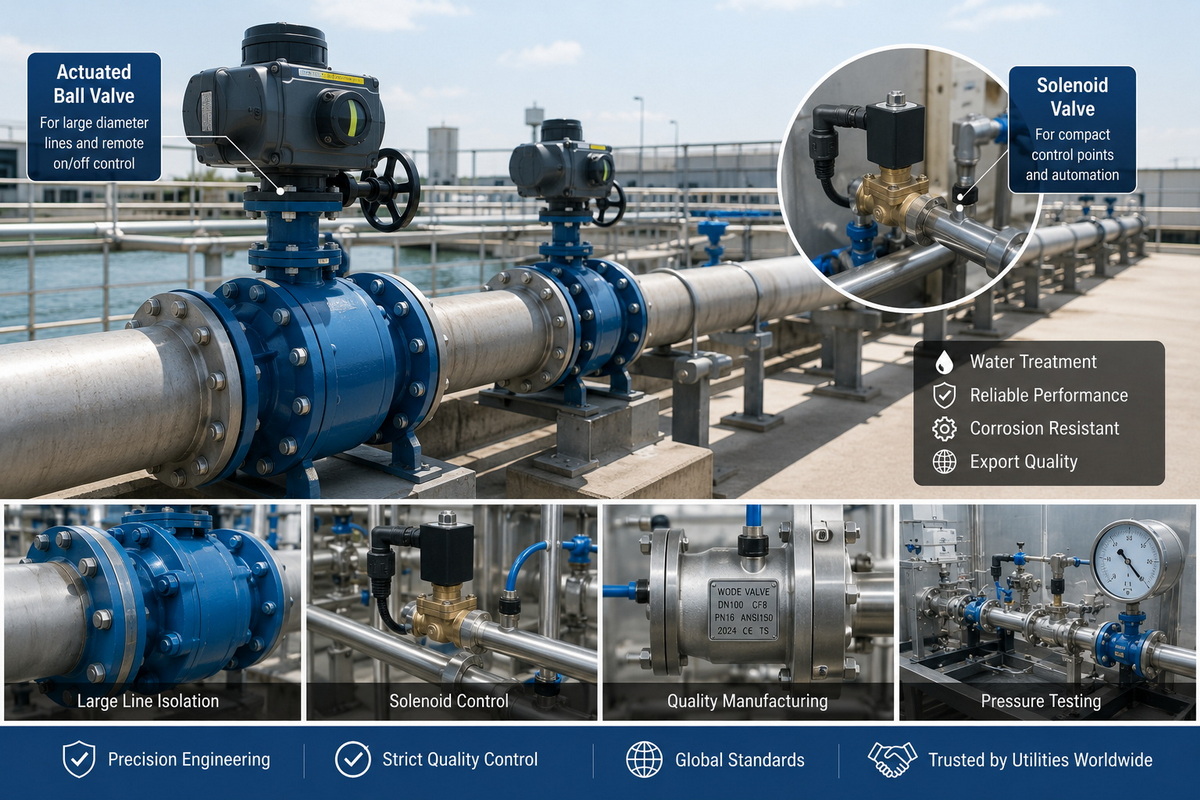
An actuated ball valve is usually the better fit when the system requires reliable isolation, larger bore performance, or better resistance to contaminated water. It is also a strong choice when the application needs stable operation over a long lifecycle with lower maintenance interruption. [plastomatic]
Typical use cases include:
- Water treatment plant isolation.
- Municipal pipeline shutoff.
- Pump station control.
- Process water distribution.
- Systems with moderate particulate content.
- Applications where manual override or fail-safe logic is important. [slideshare]
For distributors and EPC contractors, actuated ball valves also make sense when standardization, durability, and wider material options are priorities. [cwayexports]
A solenoid valve is the better choice when the process depends on rapid switching, compact layout, and smaller flow lines. It is frequently used where quick on/off control is more important than pressure capacity or full-bore flow. [tameson]
Typical use cases include:
- Irrigation control.
- Pneumatic circuits.
- Compact utility skids.
- Small-diameter water lines.
- High-frequency switching applications.
- Systems with limited installation space. [tameson]
If the media is clean and the line size is small, a solenoid valve can deliver excellent performance with a simpler package. [measuremonitorcontrol]
A more practical way to choose is to look beyond "valve type" and evaluate the full operating environment. Three factors often decide the winner in real projects:
1. Media quality. Dirty water or solids push the decision toward actuated ball valves because the rotating ball is more forgiving than a fine internal solenoid passage. [tameson]
2. Pipe diameter. As line size increases, actuated ball valves become more practical, while solenoid valves become less economical and less suitable. [tameson]
3. Failure behavior. In critical water systems, the valve's behavior during power loss can be as important as its normal operating mode. Solenoid valves often default to normally open or normally closed behavior, while actuated ball valves can be paired with fail-safe actuation strategies. [slideshare]
This is where engineering judgment matters most. A valve that is technically acceptable on paper may still be the wrong choice if maintenance access, particulate loading, or power reliability are overlooked. [msecinc]
For water treatment and municipal applications, the most common decision pattern is straightforward:
- Choose a solenoid valve when the line is small, the media is clean, and speed matters most.
- Choose an actuated ball valve when the line is larger, flow capacity matters, and the system needs better durability in real operating conditions. [valveman]
This is why many engineering teams treat solenoid valves as a control solution and actuated ball valves as an isolation or main-line solution. That distinction helps prevent undersized selection and unnecessary maintenance. [plastomatic]
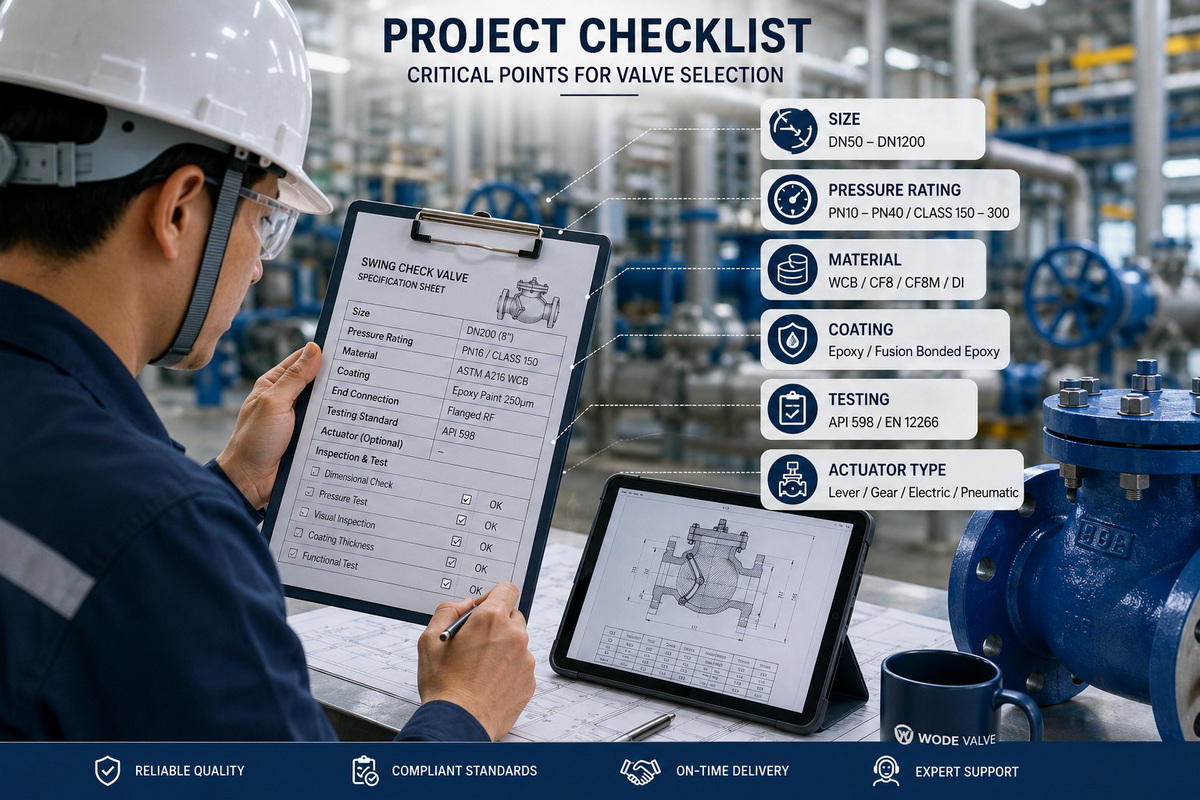
A reliable valve selection workflow can reduce project risk. Before specifying the valve, review the following:
1. Fluid type and cleanliness.
2. Working pressure and temperature.
3. Pipe size and required flow rate.
4. Duty cycle and switching frequency.
5. Power availability and fail-safe requirement.
6. Installation space and maintenance access.
7. Required materials and corrosion resistance. [cwayexports]
Using this checklist early in the project stage helps engineers avoid expensive change orders later. It also improves commissioning speed and system reliability. [msecinc]
For OEMs, valve choice affects product performance, brand reputation, and warranty exposure. For distributors, it affects stock planning, technical support load, and customer satisfaction. In municipal and water treatment projects, buyers usually prefer solutions that combine technical clarity, durable performance, and predictable lifecycle cost. [cwayexports]
That is why a manufacturer like Tianjin Wode Valve Co., Ltd. should emphasize application engineering, material selection, and documented quality control alongside product availability. This strengthens trust with international distributors, EPC contractors, and valve brands.
A strong product page or blog should not only describe the valve. It should help buyers choose correctly. For your audience, the best content angle is to highlight:
- Water treatment and municipal pipeline expertise.
- Material options for corrosion resistance.
- Consistency across OEM and private-label supply.
- Clear guidance for valve sizing and application matching.
- Quality assurance and export-ready documentation.
This approach supports both SEO and conversion because it answers the buyer's technical question while reinforcing manufacturer credibility. [msecinc]
The best choice between an actuated ball valve and a solenoid valve depends on the application, not the product category alone. If your priority is fast response in a compact system, a solenoid valve is often the right answer. If your priority is higher flow, better pressure handling, and stronger field reliability, an actuated ball valve is usually the better option. [valveman]
For water treatment and municipal pipeline projects, that distinction is especially important. A careful selection process improves uptime, reduces maintenance, and supports better long-term operating cost.
If your project involves water treatment, municipal pipelines, or OEM valve supply, use this comparison as the starting point for specification review. A well-matched valve can improve system efficiency, reduce service interruptions, and extend equipment life.
An actuated ball valve uses a quarter-turn ball mechanism for isolation and higher flow, while a solenoid valve uses an electromagnetic coil for fast on/off control. [tameson]
Actuated ball valves are often better for larger water treatment lines, while solenoid valves are better for compact, fast-switching control circuits. [valveman]
Usually not as well as an actuated ball valve. Solenoid valves are more sensitive to particulates and clogging. [tameson]
Solenoid valves are generally more compact and easier to install in tight layouts. [measuremonitorcontrol]
Actuated ball valves are usually the better choice as pipe size increases because they offer higher flow capacity and better practicality at scale. [tameson]
1. Measure Monitor Control. "Solenoid Valves vs Ball Valves: A Complete Comparison." [https://www.measuremonitorcontrol.com/news/solenoid-valves-vs-ball-valves] [measuremonitorcontrol]
2. Valveman. "Using an Actuated Ball Valve Or a Solenoid Valve For Best Fluid Control in the System." [https://valveman.com/blog/using-an-actuated-ball-valve-or-a-solenoid-valve-for-best-fluid-control-in-the-system/] [valveman]
3. Slideshare document. "Solenoid Valves or Ball Valves." [https://www.slideshare.net/slideshow/solenoid-valves-or-ball-valves/249425023] [slideshare]
4. TangoValve Group. "Motorized Ball Valve vs Solenoid Valve." [https://www.tangovalve.com/motorized-ball-valve-vs-solenoid-valve/] [tangovalve]
5. Plast-O-Matic / CubaValve. "Actuated Ball Valves vs. Solenoid Valves." [https://www.cubavalve.com/technical-article/actuated-ball-valves-vs-solenoid-valves/] [cubavalve]
6. Tameson. "Electric Ball Valve vs Solenoid Valve." [https://tameson.com/pages/electric-ball-valve-solenoid-valve] [tameson]
7. MSEC. "Guide to Industrial Valves." [https://msecinc.com/blog/guide-to-industrial-valves/] [msecinc]
8. C-Way Exports. "Introduction to Industrial Valves: Types, Applications & Selection Guide." [https://www.cwayexports.com/blog/industrial-valves-types-selection-guide/] [cwayexports]


