

Views: 222 Author: Wode Valve Publish Time: 2026-05-19 Origin: Site


Pneumatic automation has become one of the most reliable ways to open, close, and precisely control industrial valves, especially in water treatment and municipal pipeline systems where uptime and safety matter more than ever. In this guide, I will walk you through pneumatic automation from the perspective of a valve manufacturer and project consultant, combining real-world experience with up‑to‑date industry best practices. [olkptc]
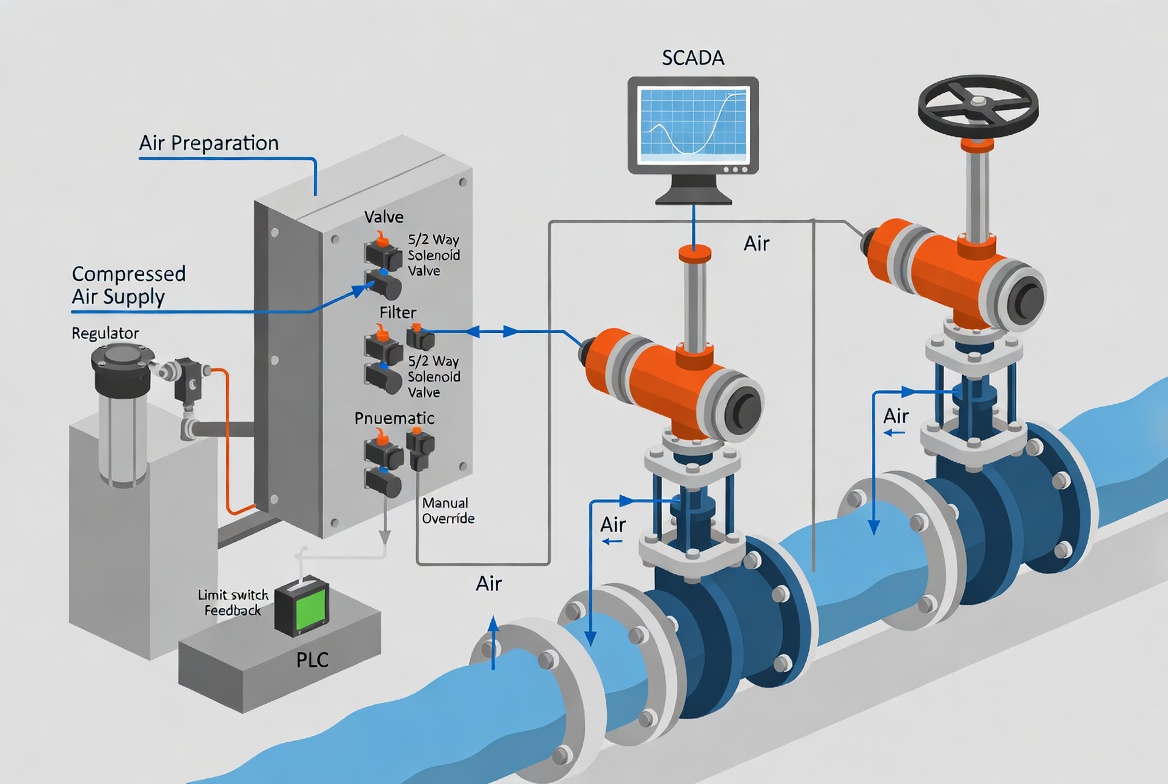
Pneumatic automation uses compressed air to move mechanical components—such as valve actuators, cylinders, and tools—to perform repeatable operations automatically. In valve systems, it typically means using an air-driven actuator to rotate or lift a valve stem so that flow can be started, stopped, or throttled without manual intervention. [festo]
From a practical standpoint, pneumatic automation sits at the intersection of:
- Process control – maintaining flow, pressure, and safety conditions
- Mechanical reliability – ensuring valves open/close in the right sequence
- System integration – linking valves with PLCs, SCADA, and plant-wide automation
In municipal water and wastewater projects, it is often the preferred solution because air systems are intrinsically safe, clean, and easy to maintain compared with many electrical or hydraulic alternatives. [discreteautomation.emerson]
To align this article with modern industrial SEO, we focus on these primary and secondary keywords:
- Primary keyword: *pneumatic automation*
- Secondary keywords: *pneumatic valve automation*, *pneumatic actuated ball valve*, *pneumatic check valve*, *air operated valve*, *pneumatic valve actuator for water treatment*
These terms reflect how engineering teams, EPC contractors, and global valve distributors typically search for solutions when specifying automated valve packages. [blog.saleslayer]
Pneumatic valves sit at the heart of any pneumatic automation system, acting as "traffic controllers" for compressed air. They regulate how much air flows, in which direction, and at what pressure—ensuring each actuator receives the right signal at the right time. [olkptc]
In a typical setup:
- A pneumatic actuator mounts on a valve (e.g., ball valve or butterfly valve).
- A control valve or solenoid valve directs compressed air into and out of the actuator.
- A controller (PLC or DCS) sends commands, often through an I/O module or fieldbus interface. [festo]
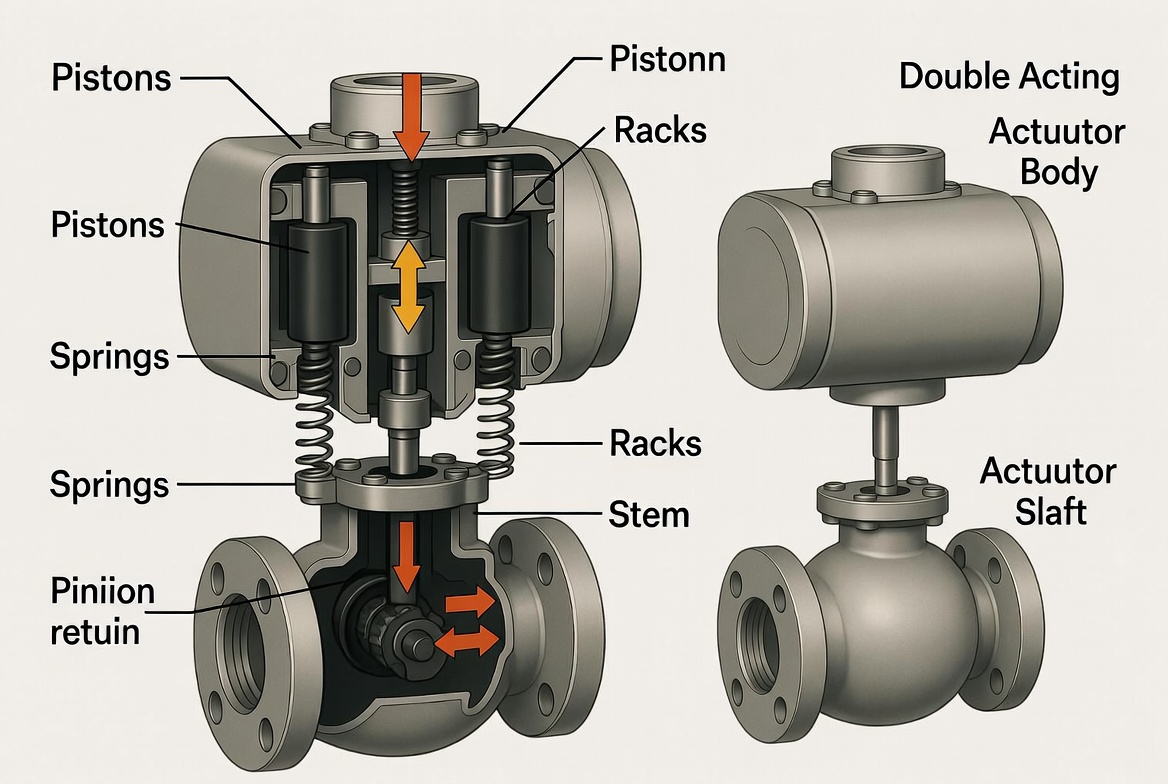
For quarter-turn valves used in water treatment—such as ball valves and butterfly valves—the most common pneumatic actuator is the rack-and-pinion design. This mechanism converts linear motion from pistons into rotary motion for the valve stem. [discreteautomation.emerson]
Industrial valves automated with pneumatics fall broadly into two groups:
- Linear valves – such as gate and globe valves, where the stem moves up and down. [valveandmeter]
- Rotary (quarter-turn) valves – such as ball and butterfly valves, where the stem rotates 90 degrees between open and closed. [festo]
Although both can be pneumatically actuated, rotary valves dominate in water treatment, municipal pipelines, and many general industrial services due to their:
- Compact, quarter-turn design
- Lower torque compared with many linear valves
- Ease of integration with standard rack‑and‑pinion actuators
Manufacturers like Tianjin Wode Valve Co., Ltd. specialize in pneumatically actuated ball valves and check valves for these applications, providing complete packages that are ready for installation and control-system integration. [olkptc]
The rack-and-pinion mechanism is the workhorse of pneumatic valve automation. It offers a simple, robust way to convert the linear motion of pistons into controlled rotary motion. [festo]
Here is how it works step by step:
1. Compressed air enters the actuator and pushes a piston or pair of pistons in a linear direction. [olkptc]
2. The pistons are connected to a rack (a toothed bar).
3. The rack engages with a pinion gear mounted on the actuator shaft.
4. As the rack moves, it turns the pinion, rotating the shaft typically by 90 degrees. [festo]
5. The shaft is mechanically coupled to the valve stem, opening or closing the valve.
Because this is a purely mechanical linkage, it offers:
- High repeatability – consistent open/close positions
- High torque output – suitable for larger diameter valves
- Durability – ideal for continuous or frequent cycling
Pneumatic actuators typically come in two main configurations, each with specific safety and control implications.
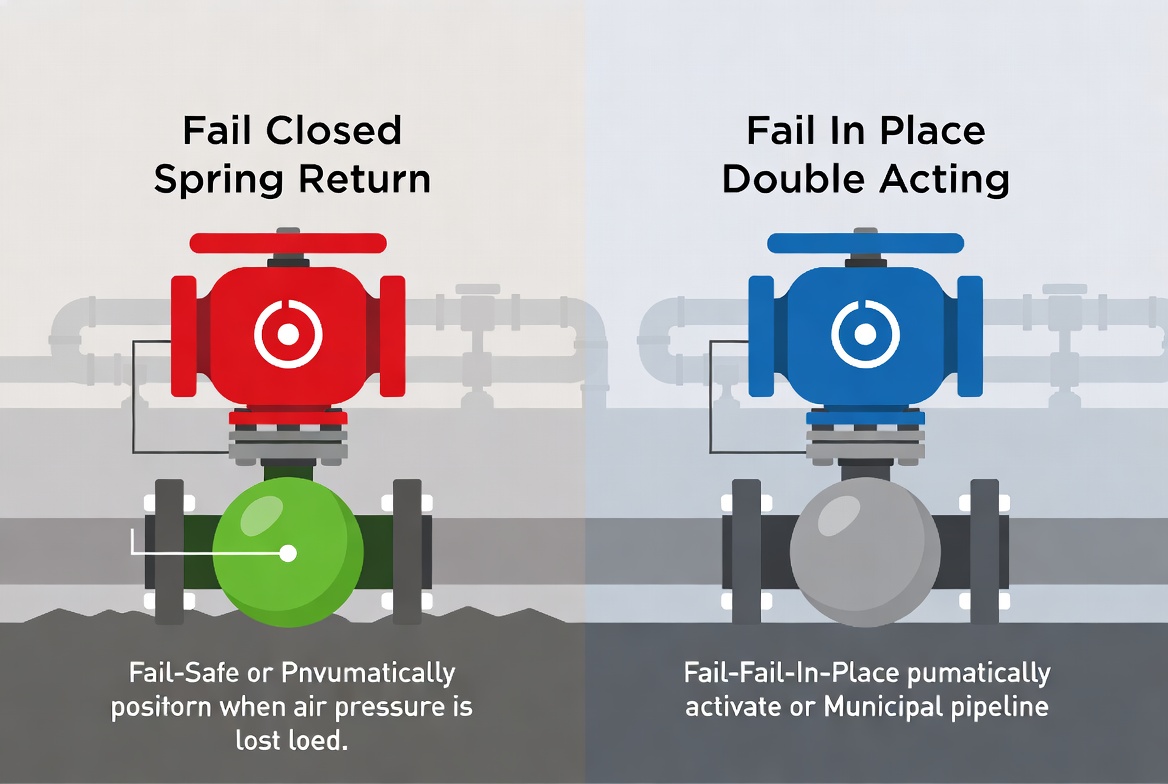
Spring-return pneumatic actuators use compressed air to move in one direction and mechanical springs to return to the fail position. [festo]
Key characteristics:
- One side of the actuator contains springs that push the rack back when air pressure is lost.
- Common configurations include Air-to-Open (ATO), Fail Closed or Air-to-Close (ATC), Fail Open.
- Widely used in safety-critical applications where the valve must move to a predictable position during air failure, such as water treatment isolation valves and overpressure protection circuits. [rodlesspneumatic]
This makes spring-return actuators ideal for:
- Fail-safe shutdown in municipal pipelines
- Emergency isolation of chemical dosing lines
- Systems where plant standards demand a default closed or open position
Double-acting actuators rely on air pressure on both sides of the piston to move the valve in either direction. [festo]
Key characteristics:
- Air is applied alternately to each side of the piston to open or close the valve.
- Without air, the actuator typically fails in place, meaning the valve stays where it was at the moment of pressure loss.
- Suitable when fail position is less critical or handled through other system safeguards.
Double-acting actuators are frequently used where:
- Precise control and high cycle rates are required
- Systems are monitored continuously by SCADA or PLC
- Energy efficiency and compact design are prioritized
Limit switches and position feedback devices transform a pneumatic actuator into a fully integrated pneumatic automation package. [discreteautomation.emerson]
A limit switch assembly typically:
- Detects whether the valve is fully open or fully closed
- Sends an electrical confirmation signal back to a PLC or DCS
- Supports visual indication (mechanical flags or LEDs) for local operators
In modern automation, this feedback is crucial for:
- Interlocks – ensuring one valve cannot open until another has closed
- Alarms – raising alerts if a valve fails to reach the commanded position
- Maintenance – monitoring cycle counts and performance trends over time
For large installations—such as municipal water networks—pneumatic valve packages with limit switches form the backbone of reliable, remotely controlled infrastructure. [discreteautomation.emerson]
From my experience working with EPC contractors and global distributors, pneumatic automation is most impactful in three types of projects:
1. Water treatment plants
2. Municipal water distribution and district metering zones
3. Wastewater and stormwater systems
In these environments, pneumatically actuated ball valves and check valves play several critical roles:
- Isolation valves – to segment pipelines for maintenance without shutting down entire networks
- Backflow protection – using pneumatic check valves that prevent reverse flow and protect pumps or sensitive equipment [rodlesspneumatic]
- Automatic switchover – managing redundant lines, filters, or tanks
- Emergency shutdown – providing quick, fail-safe isolation in response to pressure, level, or contamination alarms
Valve manufacturers like Tianjin Wode Valve Co., Ltd. collaborate closely with international valve brands and OEMs to supply complete pneumatic automation packages tailored to these scenarios. [blog.saleslayer]
Compared with purely manual valves or other types of actuation, pneumatic automation offers several compelling benefits:
- Safety in hazardous environments – compressed air is non-sparking and non-flammable, suitable for many industrial and municipal settings. [discreteautomation.emerson]
- High cycling capability – ideal for applications that open and close valves frequently.
- Fast response time – supporting advanced control strategies and emergency operations.
- Robustness – tolerant of demanding environments and temperature variations. [discreteautomation.emerson]
- Cost-effectiveness – especially attractive when plants already have a central compressed-air system.
For many water and pipeline operators, the combination of reliability, safety, and long service life makes pneumatic automation a default choice for critical valves. [rodlesspneumatic]
Even experienced teams can encounter issues when specifying or installing pneumatic automation. Based on recurring field feedback and project reviews, the most common mistakes include:
- Underestimating torque requirements – leading to sluggish or incomplete valve operation
- Ignoring air quality – contamination can damage actuators and control valves
- Overlooking fail position strategies – resulting in unsafe default states
- Poor integration with PLC/SCADA – missing feedback or limited diagnostics
- Insufficient corrosion protection – particularly in coastal or high-humidity environments
To avoid these pitfalls:
1. Always match actuator torque to the valve's required break torque under worst-case conditions.
2. Include air filtration and drying to maintain clean, dry air in line with manufacturer recommendations. [olkptc]
3. Define a clear fail-safe philosophy (fail open, fail closed, or fail in place) early in the project.
4. Standardize on feedback devices and communication protocols across the plant.
5. For water treatment and municipal systems, specify coated or corrosion-resistant actuators and mounting hardware.
When specifying pneumatic automation for ball valves and check valves in water treatment and municipal pipelines, I recommend a structured selection process.
- Medium and application – potable water, wastewater, seawater, or industrial fluids
- Pressure and temperature range – including transient conditions
- Valve size and end connections – flanged, threaded, or grooved
- Control philosophy – on/off operation or modulating control
- Fail-safe requirement – fail open, fail closed, or fail in place
- Integration level – from simple solenoid/limit switch packages to full digital valve islands
Manufacturers such as Tianjin Wode Valve Co., Ltd. provide project-specific data sheets that map these criteria to recommended valve and actuator combinations, enabling EPC teams to configure consistent solutions across large networks. [cazbah]
Pneumatic automation is evolving rapidly, especially with the introduction of digital pneumatics and motion terminals that combine software-controlled behavior with traditional valve hardware. [discreteautomation.emerson]
Recent trends include:
- Software-configurable pneumatic functions – allowing multiple control modes from a single valve terminal. [festo]
- Integrated diagnostics – monitoring pressure, cycle counts, and performance parameters in real time.
- Predictive maintenance – using data from actuators and sensors to schedule interventions before failures occur.
- Hybrid architectures – combining pneumatic actuation with electric positioners for fine control and remote tuning.
For water treatment and municipal operators, these capabilities translate into:
- Lower unplanned downtime
- Shorter commissioning cycles
- Better visibility of critical valves spread across wide geographic areas
Forward-looking manufacturers are already integrating these trends into their pneumatic ball valve and check valve packages, positioning themselves as strategic partners for smart infrastructure projects. [discreteautomation.emerson]
For EPC contractors and global distributors working with valve manufacturers, a structured implementation process is essential.
1. Define service conditions
- Medium, pressure, temperature, and required cycle frequency
- Safety requirements and applicable standards
2. Select valve type
- Quarter-turn ball valve or butterfly valve for isolation and control
- Check valve for backflow prevention
3. Size and select actuator
- Calculate torque requirements with safety margin
- Choose spring-return or double-acting based on fail philosophy
4. Specify accessories
- Limit switches, solenoid valves, positioners, local indicators
- Optional manual overrides and lockout features
5. Plan control integration
- Define wiring, signal types, and addressing for PLC or DCS
- Consider digital communication options where appropriate
6. Commission and test
- Verify stroke time, fail position, and feedback signals
- Document baseline performance and include in maintenance plans
In my experience, projects that follow this structured approach see fewer site modifications and significantly smoother commissioning phases.
| Aspect | Spring-Return Actuator | Double-Acting Actuator |
|---|---|---|
| Energy source | Air for one direction, mechanical spring for return (Air for one direction, mechanical spring for return) | Air for both open and close (Air for both open and close) |
| Typical fail position | Fail open or fail closed as defined (Fail open or fail closed as defined) | Fail in place unless supported by other safeguards (Fail in place unless supported by other safeguards) |
| Safety applications | Ideal for emergency shutdown and critical isolation valves (Ideal for emergency shutdown and critical isolation valves) | Often used where continuous control and supervision are available (Often used where continuous control and supervision are available) |
| Maintenance complexity | Additional inspection of springs and seals (Additional inspection of springs and seals) | Fewer mechanical parts, but requires reliable dual air supply (Fewer mechanical parts, but requires reliable dual air supply) |
| Common use in pipelines | Water treatment isolation, chemical dosing, safety interlocks (Water treatment isolation, chemical dosing, safety interlocks) | High-cycle process valves, non-critical lines with strong SCADA monitoring (High-cycle process valves, non-critical lines with strong SCADA monitoring) |
Information is summarized from typical manufacturer guidance and pneumatic valve application notes. [olkptc]
If you are planning or upgrading water treatment plants or municipal pipeline systems, partnering with a dedicated valve manufacturer can significantly reduce engineering risk and lifecycle cost.
As a manufacturer specializing in check valves and ball valves for water and municipal applications, Tianjin Wode Valve Co., Ltd. works closely with:
- Global distributors who need reliable OEM valve packages
- EPC contractors managing complex, multi-phase infrastructure projects
- International valve brands seeking high-quality, private-label solutions
For project consultation, detailed data sheets, or customized pneumatic automation packages, you can:
- Request a project review to evaluate your existing valve and actuation strategy
- Share your P&ID and service conditions for optimized valve-actuator selection
- Schedule an online meeting to align technical specifications and delivery timelines
Well-designed pneumatic automation does more than open and close valves—it protects assets, stabilizes processes, and keeps critical infrastructure running.
Pneumatic automation in valve systems uses compressed air to drive actuators that open, close, or modulate valves automatically, often under the control of a PLC or DCS. [olkptc]
They are popular because they offer non-sparking operation, high reliability, and fast response, making them well-suited for wet, corrosive, or safety-critical environments. [rodlesspneumatic]
Spring-return actuators use air to move in one direction and a spring to provide fail-safe movement, while double-acting actuators use air in both directions and typically fail in place when air is lost. [festo]
Limit switches provide electrical confirmation of valve positions, enabling interlocks, alarms, and more reliable control logic in PLC and SCADA systems. [discreteautomation.emerson]
Key considerations include process medium, pressure and temperature, torque requirements, fail-safe position, and the level of integration needed with existing control systems. [blog.saleslayer]
1. OLK PTC – "How Does an Air Control Valve Work in Pneumatic Automation Applications?" (2026). [olkptc]
2. Festo – "What is a pneumatic valve?" [festo]
3. Sales Layer – "SEO for Manufacturing Companies: The 2026 Strategy Guide". [blog.saleslayer]
4. Cazbah – "Commercial and Industrial SEO Strategies That Actually Work". [cazbah]
5. Wildcat Digital – "How Do You Write E-E-A-T Content?". [wildcatdigital.co]
6. Another Concept – "EEAT Guidelines: What Are They and How Do I Follow Them?". [anotherconcept.co]
7. Bepto Pneumatic – "A Guide to Pneumatic Check Valves and Their Critical Functions". [rodlesspneumatic]
8. Emerson AVENTICS – "Pneumatic Valves – Discrete Automation". [discreteautomation.emerson]
9. ValveMan – "Pneumatic Automation Explained by the ValveMan Valve Store".


