

Views: 222 Author: Wode Valve Publish Time: 2026-05-18 Origin: Site


When you run liquid nitrogen (LN₂) at around -196°C (-320°F), your cryogenic control valve is either your best safeguard or your biggest risk. As an engineer and long‑time valve supplier into water treatment, municipal networks, and low‑temperature industrial systems, I have seen projects succeed or fail largely on how carefully the cryogenic control valve was selected, installed, and maintained. [measuremonitorcontrol]
In this guide, I will walk through how to specify and set up a liquid nitrogen cryogenic control valve that does not freeze up, leak, or drift out of control after a few thermal cycles. I will also explain how an experienced manufacturer of check valves and ball valves like Tianjin Wode Valve Co., Ltd. can help you reduce total lifecycle risk instead of just cutting unit price.
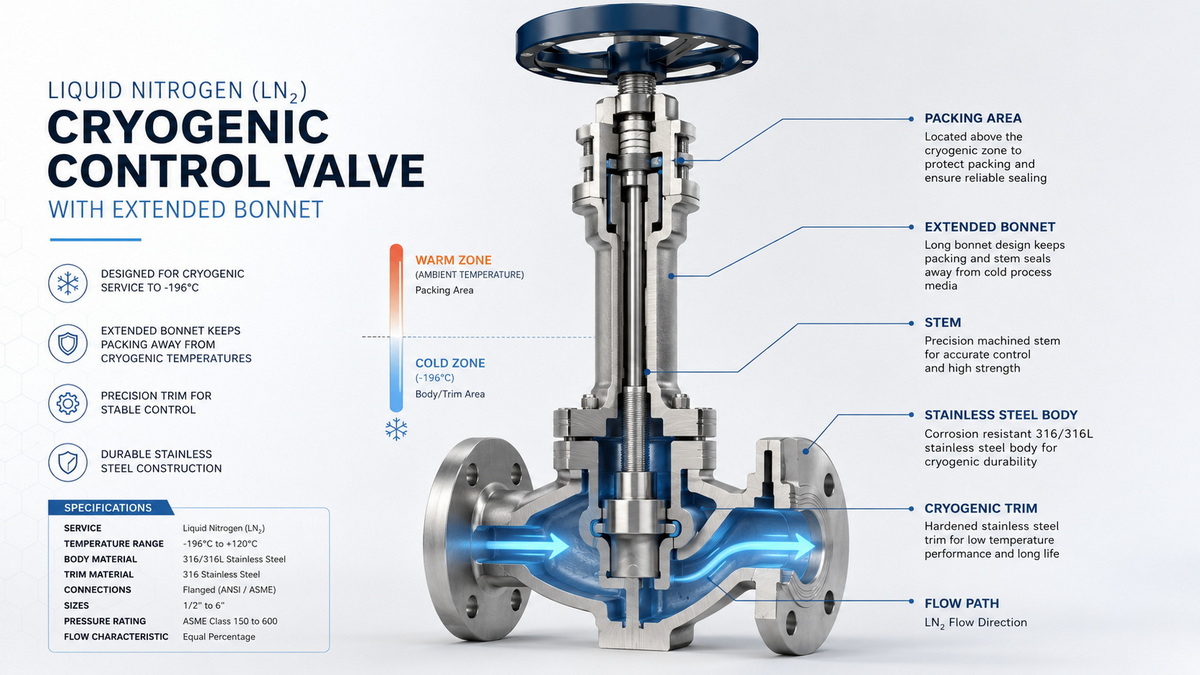
A liquid nitrogen cryogenic control valve is a valve designed to regulate LN₂ flow at ultra‑low temperatures, typically below -150°C, without losing sealing performance, controllability, or structural integrity. It usually integrates an extended bonnet and specialized trims to keep critical components out of the coldest zone while still maintaining precise flow control. [measuremonitorcontrol]
Key characteristics include:
- Ultra‑low temperature rating (down to -196°C depending on design). [measuremonitorcontrol]
- Compatible materials such as austenitic stainless steels and cryogenic‑grade seals. [prcvalve]
- Extended bonnet that relocates packing above the cryogenic zone. [measuremonitorcontrol]
- Tight shutoff and repeatable control over wide turndown.
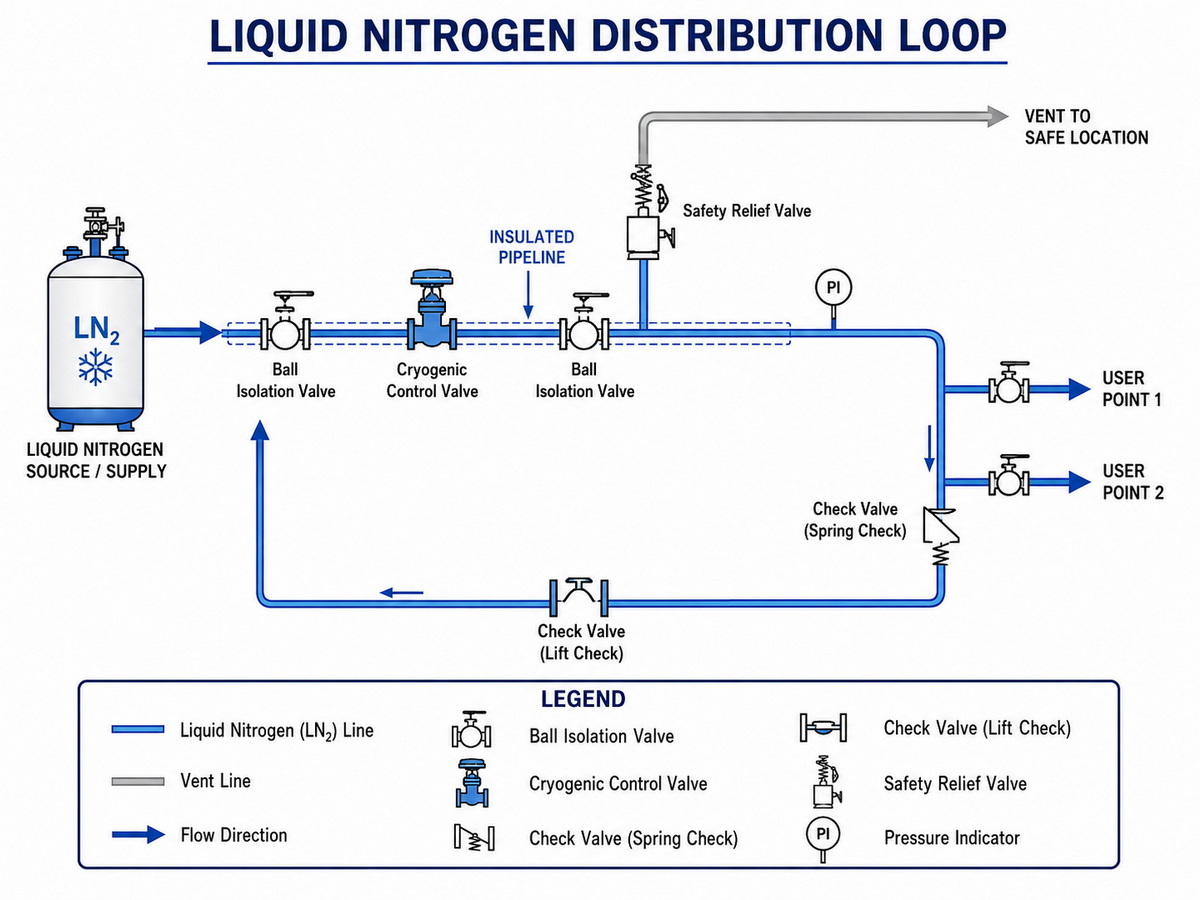
In many plants, this valve operates as the "throttle" in a liquid nitrogen distribution loop feeding laboratories, test stands, medical storage, or industrial cooling equipment.
At ambient temperature, a mis‑sized or poorly specified valve is a nuisance. In cryogenic service, it can become a safety, reliability, and cost problem very quickly.
Common failure modes I see in the field include:
- Frozen trim or internals when cold spots are not properly managed.
- Leakage at the stem packing caused by thermal contraction and wrong sealing materials. [measuremonitorcontrol]
- Seat damage due to flashing, cavitation, or dry‑out at extremely low temperatures. [plantengineering]
- Unstable control when the valve is oversized or installed in a poor orientation.
Meanwhile, the business context is changing: the global cryogenic valve market is forecast to reach well over USD 3 billion by 2033, driven by LNG, industrial gases, and emerging energy applications. That growth means more run hours, more demanding duty cycles, and far less tolerance for unplanned shutdowns. [fortunebusinessinsights]
If you specify a robust cryogenic ball or globe control valve backed by a competent manufacturing partner, you can significantly cut through‑life cost and operator headaches.
From an engineering standpoint, five design areas decide whether your valve will survive liquid nitrogen service.
For LN₂, austenitic stainless steels (such as 304/316 or 3.5% nickel steels) are widely used thanks to their toughness at low temperature and resistance to brittle fracture. [prcvalve]
Important considerations:
- Impact toughness at -196°C to avoid brittle failure.
- Weldability and cleanliness, especially for oxygen‑rich or high‑purity services. [measuremonitorcontrol]
- Corrosion resistance against any contaminants or ambient moisture.
As a manufacturer focused on water and municipal pipelines, Tianjin Wode Valve routinely works with specialized alloys for low‑temperature water and brine applications, and the same material discipline carries over to cryogenic configurations.
An extended bonnet lifts the stem packing out of the cryogenic zone, bringing it nearer to ambient temperature so seals can function correctly. [measuremonitorcontrol]
A good extended bonnet design will:
- Provide enough length to maintain packing above a defined minimum temperature.
- Integrate vent holes to allow safe discharge of any vaporized fluid.
- Use stem guides that maintain alignment as temperatures fluctuate.
Without a proper extension, packing materials may harden, crack, or shrink, leading to leaks and potential oxygen‑deficient atmospheres around the valve.
At -196°C, standard elastomers become brittle. Your sealing system must therefore be engineered for cryogenic service.
Key options include:
- Metal‑to‑metal seats for severe conditions and high cycle frequencies. [measuremonitorcontrol]
- PTFE‑based or cryogenic‑grade soft seats where bubble‑tight shutoff is required and operating conditions allow.
- Low‑temperature stem seals using PTFE, graphite, or composite packing systems.
Cryogenic ball valves in particular can be configured with cavity relief, anti‑blowout stems, and live‑loaded packing to maintain tightness across thermal cycles. [prcvalve]
The valve must deliver stable, predictable control over the required flow range.
Engineering best practices include:
- Matching valve Cv to maximum and minimum flow to avoid hunting or stiction at low openings. [plantengineering]
- Choosing the appropriate valve characteristic (equal‑percentage for wide range control, linear for proportional systems).
- Considering two‑stage or multi‑valve arrangements where the pressure drop is very high to limit flashing.
In many cryogenic LN₂ systems, valves see infrequent but critical operation. That makes actuator reliability and feedback crucial.
Typical design choices:
- Manual gear operators for isolated or backup lines.
- Pneumatic or electric actuators for automated process control.
- Positioners and limit switches rated for the expected ambient conditions.
Combining a robust mechanical design with reliable actuation reduces the risk of stuck valves during emergency shut‑off or fast process changes.
Operating at around -196°C brings unique physical challenges that standard valves are not designed to handle.
The main issues you must manage are:
- Thermal contraction: Metals and seals shrink, changing clearances and compressive loads.
- Boil‑off and flashing: LN₂ flashes to gas when exposed to higher temperatures, which can erode trim and destabilize control. [future4200]
- Ice formation: Ambient moisture can freeze on external surfaces, interfering with operation and indicating potential insulation or venting problems. [future4200]
- Oxygen deficiency risk: Venting nitrogen displaces oxygen in enclosed spaces, which requires careful layout and safety planning. [future4200]
A cryogenic control valve that is engineered correctly addresses these problems at the design level, rather than leaving them to be "managed" through emergency maintenance.
Based on real projects and accepted industry guidance, here is a practical workflow for specifying a liquid nitrogen control valve. [plantengineering]
1. Define your process conditions
- Minimum and maximum temperature (down to -196°C).
- Operating and design pressures.
- Required flow range and control accuracy.
2. Clarify the valve function
- On/off isolation, modulating control, or both. [measuremonitorcontrol]
- Frequency of operation and expected cycle life.
3. Select valve type and configuration
- Ball valve for tight shutoff, fast action, and low pressure drop.
- Globe/control valve for fine throttling and complex control curves. [measuremonitorcontrol]
4. Choose materials and standards
- Austenitic stainless or cryogenic carbon steel for body/bonnet. [prcvalve]
- Cryogenic‑rated gaskets, seats, and packing.
- Compliance with relevant standards (e.g., ASME, API, ISO where applicable). [plantengineering]
5. Specify bonnet extension and insulation
- Define extension length based on minimum packing temperature.
- Coordinate with piping insulation and support design.
6. Define actuation and accessories
- Manual, pneumatic, or electric actuation depending on system criticality.
- Positioners, limit switches, and feedback devices suited to your control system.
7. Plan for testing and quality assurance
- Hydrostatic and leak testing at specified pressures. [plantengineering]
- Functional testing through several thermal cycles, where appropriate.
Working with a manufacturer that already delivers check valves and ball valves into demanding water and municipal applications can simplify this process, because they are used to handling complex specifications, QA documentation, and third‑party inspections.
Good hardware can still fail if installation is careless. Experienced field technicians and EPC contractors repeatedly highlight the same best practices. [visserssales]
- Follow the manufacturer's orientation recommendations to ensure proper drainage and avoid trapped liquid between two closed valves.
- Avoid pockets and dead legs near the valve where liquid can accumulate and flash violently. [future4200]
- Use compatible gaskets and fittings designed for cryogenic temperatures.
- Support the piping and valve body to handle the weight of insulation and dynamic loads.
- Keep valves and seats clean during installation to prevent debris‑induced leakage. [svf]
In cryogenic service, you should treat installation as part of the engineering design—not an afterthought.
For liquid nitrogen systems, proactive maintenance is cheaper than incident response. Industry guidance for industrial valves and cryogenic equipment emphasizes regular inspections and record‑keeping. [visserssales]
Essential steps include:
- Routine external inspections
- Check for frost patterns, unexpected ice buildup, or signs of leakage.
- Inspect actuators, position indicators, and feedback wiring. [visserssales]
- Periodic functional tests
- Fully stroke the valve to confirm smooth movement.
- Verify tight shutoff at operating pressure and temperature.
- Seal and packing checks
- Look for weeping around the stem or body joints.
- Replace packing with cryogenic‑rated materials according to the maker's recommendations. [visserssales]
- Cleanliness and documentation
- Keep the valve and surrounding area clean to limit corrosion and contamination. [tooltalkshow]
- Maintain detailed records of inspections, interventions, and component replacements.
These practices significantly extend valve service life and reduce unscheduled downtime across the plant. [visserssales]
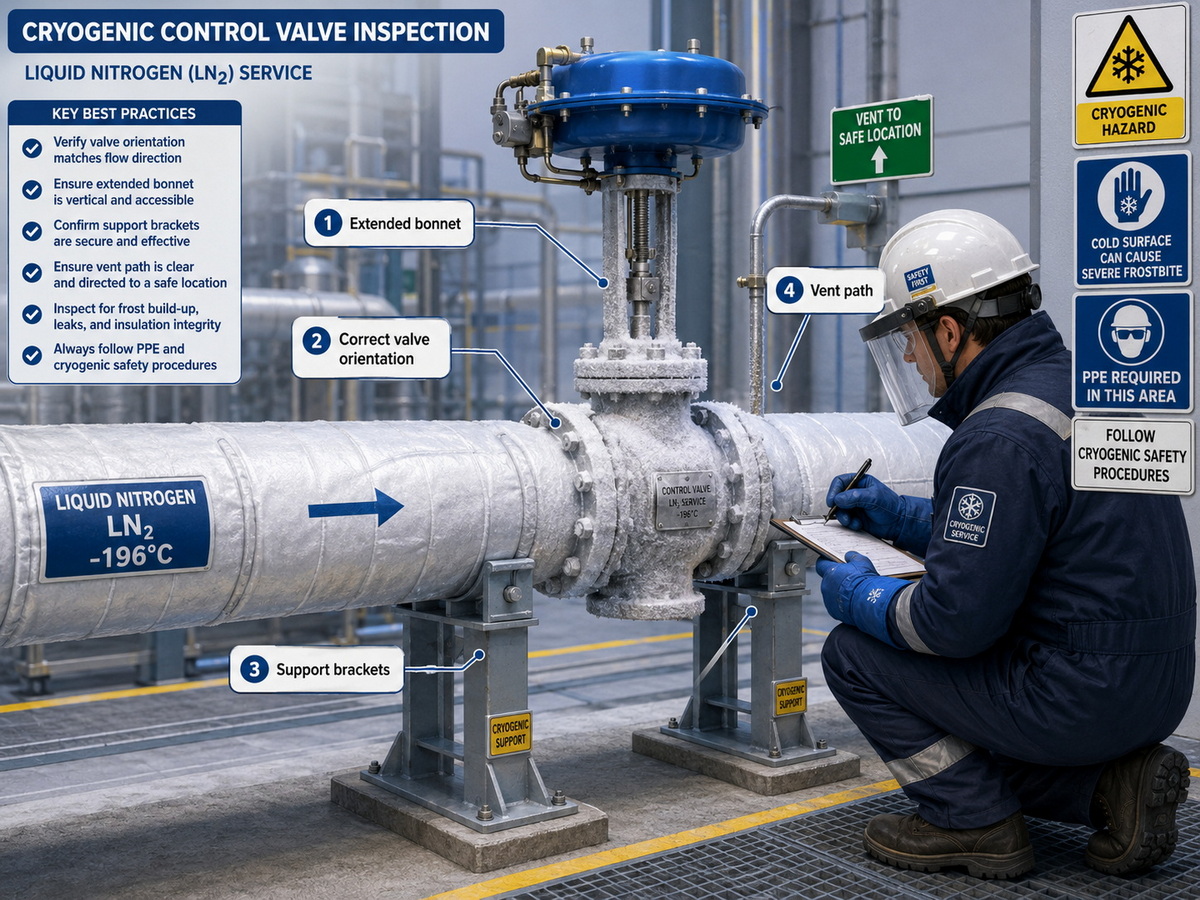
Liquid nitrogen is inert, but it can be dangerous when mishandled. Many institutional safety guides highlight common precautions. [future4200]
When working around LN₂ cryogenic control valves:
- Never trap liquid nitrogen between two closed valves, as thermal expansion can generate excessive pressure. [future4200]
- Ensure pressure relief valves and vent paths remain unobstructed.
- Wear appropriate PPE, including insulated gloves and face protection, during any intervention. [future4200]
- Provide adequate ventilation in enclosed spaces to avoid oxygen depletion.
- Treat any unusual venting or ice growth as a warning and follow your site's emergency procedures. [future4200]
A correctly specified and installed valve reduces these risks, but it never replaces safety training and clear operating procedures.
As a manufacturer specializing in check valves and ball valves, we often see these two valve types playing critical supporting roles in cryogenic liquid nitrogen networks.
- Cryogenic ball valves
- Provide on/off isolation with low pressure drop.
- Can be designed with extended bonnets, cavity relief, and cryogenic seats. [prcvalve]
- Cryogenic check valves
- Prevent reverse flow during cooldown and warm‑up cycles.
- Reduce the risk of pump damage or unexpected pressure surges.
When the main cryogenic control valve is combined with properly selected check and isolation ball valves from a coordinated product line, you get a balanced system with fewer compatibility issues and simpler maintenance.
The cryogenic valve market is growing steadily, supported by LNG, industrial gases, and advanced energy projects, with forecasts indicating multi‑billion‑dollar revenues and mid‑single‑digit annual growth rates over the coming decade. [techsciresearch]
For asset owners, this means:
- More high‑duty cryogenic systems entering operation.
- Increased focus on lifecycle cost and reliability, not just purchase price.
- A preference for trusted suppliers who can support global distribution, EPC schedules, and OEM branding.
Manufacturers like Tianjin Wode Valve Co., Ltd., already serving global distributors, EPC contractors, and international brands, are positioned to translate standard water and municipal valve experience into robust cryogenic solutions and private‑label programs.
In one representative scenario, a facility running a small lab LN₂ network experienced frequent freezing and erratic flow through a standard isolation valve misused as a control valve. Operators compensated manually, which increased consumption and risked spills.
After replacing the unit with a properly sized cryogenic ball control valve with an extended bonnet, and adding a downstream check valve to prevent backflow during cylinder changeovers, the system saw:
- Stable flow control across the full operating range.
- Reduced unplanned interventions by maintenance staff.
- Safer operating conditions with fewer ice‑related obstructions.
This kind of incremental upgrade is typical: the cost of a dedicated cryogenic control valve is usually modest compared to the risk and operating penalties of using the wrong valve.
Use this condensed checklist when you specify a liquid nitrogen cryogenic control valve:
- Process conditions confirmed (temperature, pressure, flow).
- Valve type chosen (ball vs. globe) with clear function (on/off vs. control).
- Materials verified for -196°C operation and relevant standards.
- Extended bonnet length and insulation coordinated with piping.
- Cryogenic‑grade seats, seals, and packing specified.
- Actuation and feedback matched to the control system.
- Installation, maintenance, and safety procedures documented.
If you are planning or upgrading a liquid nitrogen system, don't treat the cryogenic control valve as just another catalog item. Involve your valve partner early, share your real operating conditions, and ask for engineering support on materials, sizing, and layout.
As a dedicated manufacturer of check valves and ball valves for water treatment and municipal pipeline applications, Tianjin Wode Valve Co., Ltd. can work with your engineering team, EPC contractor, or distribution network to:
- Configure cryogenic ball and check valves tailored to your LN₂ service.
- Provide consistent quality documentation and testing data for project approvals.
- Support long‑term supply for global distribution and OEM branding needs.
Reach out with your process data and project requirements to discuss a valve configuration that will keep your liquid nitrogen flowing safely and reliably for the long term.
You should ensure the valve is explicitly rated down to around -196°C (-320°F), which matches the boiling point of liquid nitrogen at atmospheric pressure. [measuremonitorcontrol]
In most cases, yes; an extended bonnet keeps the stem packing in a warmer region, which is critical for maintaining sealing performance and preventing leaks at cryogenic temperatures. [measuremonitorcontrol]
Insulation alone is not enough; the valve must be designed and tested for cryogenic service, including appropriate seats, seals, cavity relief, and an extended bonnet where required. [prcvalve]
Inspection intervals depend on duty cycle, but many facilities adopt regular visual checks and periodic functional tests, supported by detailed maintenance records to track performance over time. [plantengineering]
The main risks are trapped liquid between closed valves, over‑pressurization, oxygen‑deficient atmospheres, and ice‑related obstructions, all of which can be mitigated through proper design, venting, and operating procedures. [future4200]
1. The Insight Partners – "Cryogenic Control Valve Market Size & Emerging Trends 2034". [Link] [theinsightpartners]
2. Fortune Business Insights – "Cryogenic Valve Market Size, Share, Growth". [Link] [fortunebusinessinsights]
3. TechSci Research – "Cryogenic Control Valve Market is expected to Grow with a CAGR of …". [Link] [techsciresearch]
4. Measure Monitor Control – "Cryogenic Valves – A Complete Guide". [Link] [measuremonitorcontrol]
5. Plant Engineering – "Best practices for selecting and maintaining industrial valves". [Link] [plantengineering]
6. Future4200 – "A Practical guide to liquid nitrogen tanks – Safety Regulation". [Link] [future4200]
7. XinTai Valve Group – Cryogenic ball valve data. [Link] [prcvalve]
8. XinTai Valve Group – Cryogenic valve body material and temperature range. [Link] [prcvalve]
9. Vissers Sales Corp – "Valve Maintenance 101: Best Practices for Longevity and Optimal Performance". [Link] [visserssales]
10. SVF Flow Controls – "Best Practices When Installing Valves for Pharmaceutical Applications". [Link] [svf]
11. ToolTalkShow – "10 Expert Tips for Choosing the Right Liquid Nitrogen Valve". [Link] [tooltalkshow]
12. Coherent Market Insights – "Cryogenic Valves Market Share and Opportunities 2026–2033". [Link] [coherentmarketinsights]


