

Views: 222 Author: Wode Valve Publish Time: 2026-06-27 Origin: Site


When engineers and procurement teams select a valve for water treatment or municipal pipeline service, the decision is rarely about price alone. The right ball valve must match the media, pressure, temperature, actuation method, maintenance expectations, and long-term reliability goals of the system. [quickcreator]
At Tianjin Wode Valve Co., Ltd., we see the same pattern repeatedly: the best valve is not always the most complex one, but the one that is correctly matched to the application. In our experience, a well-specified ball valve can reduce leakage risk, simplify operation, and improve lifecycle value in demanding infrastructure projects. [quickcreator]
A ball valve is a quarter-turn valve that uses a rotating ball with a bore to start or stop flow. Because it opens and closes quickly, it is widely used in isolation, distribution, and utility systems where reliable shutoff matters more than fine throttling. [quickcreator]
For water treatment and municipal pipelines, ball valves are especially attractive because they offer:
- Fast operation.
- Low pressure drop when fully open.
- Strong sealing performance.
- Compatibility with manual or automated actuation.
- Good service life when matched to the correct seat and body materials. [quickcreator]
The original article gives a broad overview of valve types, but it lacks several things modern readers expect from a high-performing technical article. It does not go deep enough into application-specific selection, does not reflect the realities of municipal and water treatment procurement, and gives limited guidance on material choice, actuation, or lifecycle trade-offs. [quickcreator]
It also includes many valve categories that may be useful in general industry education, but they dilute the focus for a manufacturer specializing in ball valves. For SEO and UX, a more useful article should answer the questions readers actually ask: Which ball valve type should I use? Which seat material fits water service? When should I choose manual, pneumatic, or electric operation? [quickcreator]
Not all ball valves serve the same purpose. In water treatment and municipal networks, the most relevant categories usually include:
- Floating ball valves for general-purpose isolation.
- Trunnion mounted ball valves for larger sizes and higher pressure service.
- Top-entry ball valves for easier maintenance in critical systems.
- Fully welded ball valves for buried or long-life installations.
- V-port ball valves where limited flow control is needed, though they are still better viewed as control-support valves rather than precision throttling valves. [developers.google]
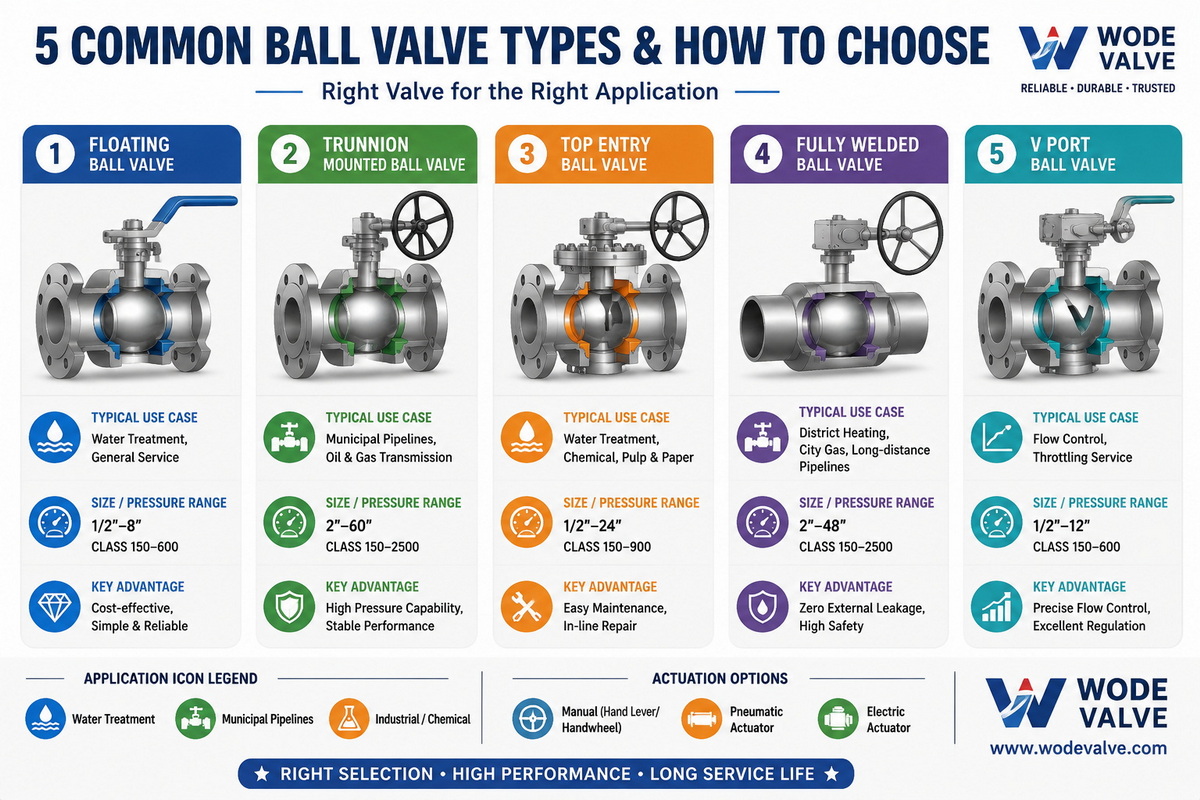
Floating ball valves are common in medium and smaller pipeline sizes. The ball is not fixed in place; line pressure helps press the ball against the downstream seat, improving shutoff performance. [quickcreator]
They are widely used in water treatment skids, distribution branches, and auxiliary piping. Their key advantage is simplicity, which often translates into lower cost and easier replacement. For many utility applications, this is the practical default choice when pressure and size remain within design limits. [quickcreator]
Trunnion mounted valves are better suited to larger diameters, higher pressures, and demanding municipal or transmission-line service. The ball is supported by trunnions, which reduces operating torque and helps the valve perform more reliably under heavy loads. [quickcreator]
This design is often preferred when automation is required or when the valve must remain stable during frequent operation. For EPC contractors, the lower torque requirement can simplify actuator selection and reduce operating stress over time. [quickcreator]
Top-entry designs are useful when maintenance access matters. Instead of removing the valve from the line, technicians can access internal parts from the top, reducing downtime in critical water treatment systems. [quickcreator]
This feature can be especially valuable in plants that cannot easily shut down a line for long periods. In practice, top-entry valves often justify their higher initial cost through lower lifecycle disruption. [quickcreator]
Fully welded ball valves are built to minimize leakage risk and improve long-term durability. They are frequently used in buried service, district heating, and long-distance municipal pipelines where the valve is expected to operate for years with limited intervention. [quickcreator]
Because the body is welded, the valve is more difficult to disassemble, but that trade-off can be acceptable in applications where external leakage prevention is a priority. For infrastructure owners, this design is often chosen for reliability rather than convenience. [quickcreator]
Selecting a ball valve is not just a technical exercise. It is a system-level decision that affects operation, maintenance, uptime, and cost. The best process is to evaluate the application from several angles rather than focusing on a single specification. [quickcreator]
Start by identifying the job the valve must perform. Is it for full shutoff, line isolation, emergency closure, or limited flow regulation? Ball valves excel in isolation and quick shutoff, but they are not usually the first choice for precise throttling. [quickcreator]
Valve sizing must align with pipe size, system pressure, and flow requirements. An undersized valve can create excessive pressure loss, while an oversized valve can increase cost without improving performance. [quickcreator]
For municipal systems, the practical question is not only "Will it fit?" but also "Will it operate efficiently over the full duty cycle?" That mindset helps prevent overspecification and underperformance. [quickcreator]
Material selection must reflect the media, water chemistry, temperature, and corrosion environment. For clean water, stainless steel or ductile iron bodies may be suitable depending on the project specification. For more aggressive service, material compatibility becomes even more important. [quickcreator]
Seat materials matter just as much as the body. PTFE and reinforced PTFE are common in many ball valve applications because they help balance sealing performance and chemical resistance. [developers.google]
Ball valves can be operated manually or automated with pneumatic or electric actuators. Manual operation is suitable for simple systems and low-frequency use. Automated operation is often better in large networks, remote stations, or locations where faster response is needed. [quickcreator]
For municipal projects, actuator choice often comes down to control philosophy. If the valve must integrate with a SCADA system or remote monitoring platform, electric or pneumatic actuation may be the better long-term decision. [quickcreator]
A reliable valve starts with the right material pairing. In our manufacturing experience, many service problems trace back not to valve design, but to poor material selection at the specification stage. [quickcreator]
| Component | Common Options | Best Use Case |
|---|---|---|
| Body | Carbon steel, stainless steel, ductile iron | Depends on corrosion risk, pressure, and budget |
| Ball | Stainless steel, chrome-plated steel | Smooth operation and corrosion resistance |
| Seat | PTFE, reinforced PTFE, RPTFE | Sealing performance and chemical compatibility |
| Stem seal | PTFE, graphite, elastomeric seals | Depends on temperature and media |
| End connection | Flanged, threaded, welded, socket weld | Depends on installation and maintenance needs |
For water treatment and municipal pipelines, corrosion resistance and seat reliability usually matter more than novelty. The most effective solution is often the one that maintains stable sealing behavior after many opening and closing cycles. [quickcreator]

Ball valves are widely used across water infrastructure because they provide dependable shutoff and straightforward operation. Common applications include:
- Raw water intake lines.
- Treated water distribution.
- Pump isolation.
- Filtration and backwash systems.
- Chemical dosing lines.
- Metering and bypass arrangements.
- Plant utility piping. [quickcreator]
In these systems, the valve's value is not just in stopping flow. It is in helping operators isolate equipment quickly, protect downstream assets, and keep the facility running safely. [quickcreator]
From a manufacturer's point of view, one of the biggest mistakes buyers make is treating every valve as a commodity. That approach can lead to poor seat selection, mismatched actuation, and avoidable maintenance problems later. [quickcreator]
A better approach is to define the application first, then match the valve to the duty. For example, a compact floating ball valve may be ideal for a plant branch line, while a trunnion mounted valve may be the better choice for a high-duty municipal transmission line. The logic is simple: the higher the operational risk, the more important the engineering choice becomes. [quickcreator]
Even a high-quality valve can underperform if installation is poor. Before commissioning, verify alignment, end connection integrity, actuator calibration, and seat compatibility with the process fluid. [quickcreator]
A practical maintenance routine should include:
1. Visual inspection for leakage.
2. Torque or actuator verification.
3. Seat and stem seal checks.
4. Cycle testing on critical valves.
5. Recordkeeping for replacement and service intervals. [quickcreator]
For water utilities, documentation matters as much as hardware. A valve that is easy to identify, track, and service will usually deliver better lifecycle value than one that simply meets minimum specification. [quickcreator]

For distributors, EPC contractors, and international valve brands, sourcing is not only about product price. It is about consistent quality, specification support, and a supplier that understands infrastructure requirements. [quickcreator]
Tianjin Wode Valve Co., Ltd. focuses on ball valve manufacturing for water treatment and municipal pipeline applications. That focus allows us to provide more relevant engineering support, more practical recommendations, and better alignment with project specifications. [quickcreator]
If you are specifying ball valves for water treatment or municipal pipeline projects, choose a supplier that can support both product performance and application selection. Contact Tianjin Wode Valve Co., Ltd. to discuss your technical requirements, request drawings, or evaluate a project-specific solution. [quickcreator]
A ball valve provides fast quarter-turn operation, strong shutoff performance, and low pressure drop when fully open. [quickcreator]
Ball valves are mainly designed for isolation and shutoff. They can be used for limited flow adjustment in some cases, but they are not ideal for precise throttling. [quickcreator]
Trunnion mounted and fully welded ball valves are often preferred for larger or higher-pressure municipal applications because they support heavier service conditions. [quickcreator]
PTFE and reinforced PTFE are commonly used because they offer good sealing and chemical compatibility in many water applications. [developers.google]
Actuator selection affects response speed, automation, safety, and integration with plant control systems. The wrong actuator can increase operating difficulty and maintenance cost. [quickcreator]
1- ValveMan. "Understanding the Different Types of Valves for Your Application." [https://valveman.com/blog/understanding-the-different-types-of-valves-for-your-application/] [quickcreator]
2- Google Search Central. "Creating Helpful, Reliable, People-First Content." [https://developers.google.com/search/docs/fundamentals/creating-helpful-content] [developers.google]
3- Google Search Central Blog. "Our latest update to the quality rater guidelines: E-A-T gets an extra E for Experience." [https://developers.google.com/search/blog/2022/12/google-raters-guidelines-e-e-a-t] [developers.google]
4- Google Search Central. "Intro to Product Structured Data on Google." [https://developers.google.com/search/docs/appearance/structured-data/product] [developers.google]
5- QuickCreator. "Industrial SEO Best Practices for Pumps, Valves & Flow Control (2025)." [https://quickcreator.io/blog/industrial-seo-best-practices-pumps-valves-flow-control-2025/] [quickcreator]


